
Swedish Swimming 2026: 5 Insights from a Summer of Records
Sjöström's comeback, four Swedish records in Borås and a youth generation that owns the Nordics: five insights from the Swedish swimming summer of 2026.
Also in Svenska · Deutsch · Español · Français · Italiano · Nederlands · Norsk · Dansk · Suomi
The water has barely stopped rippling after one of the most intense periods in modern Swedish swimming history. From the electric atmosphere at Alidebergsbadet in Borås to the sweltering pools of Rome and Oslo, the past few weeks have delivered everything from heroic comebacks to a generational shift that is sending shockwaves through the swimming world. It is a time marked by both technical brilliance and a striking belief in the future. Here are five key insights from the swimming summer of 2026.
Sjöström's Comeback: A Show of Strength That Shakes the World Elite
When Sarah Sjöström dived in at Sette Colli in Rome, the eyes of the world were on her. Ten months after becoming a mother, she swam her first international butterfly race, an event that demands a physical explosiveness and strength few can maintain after a long break.
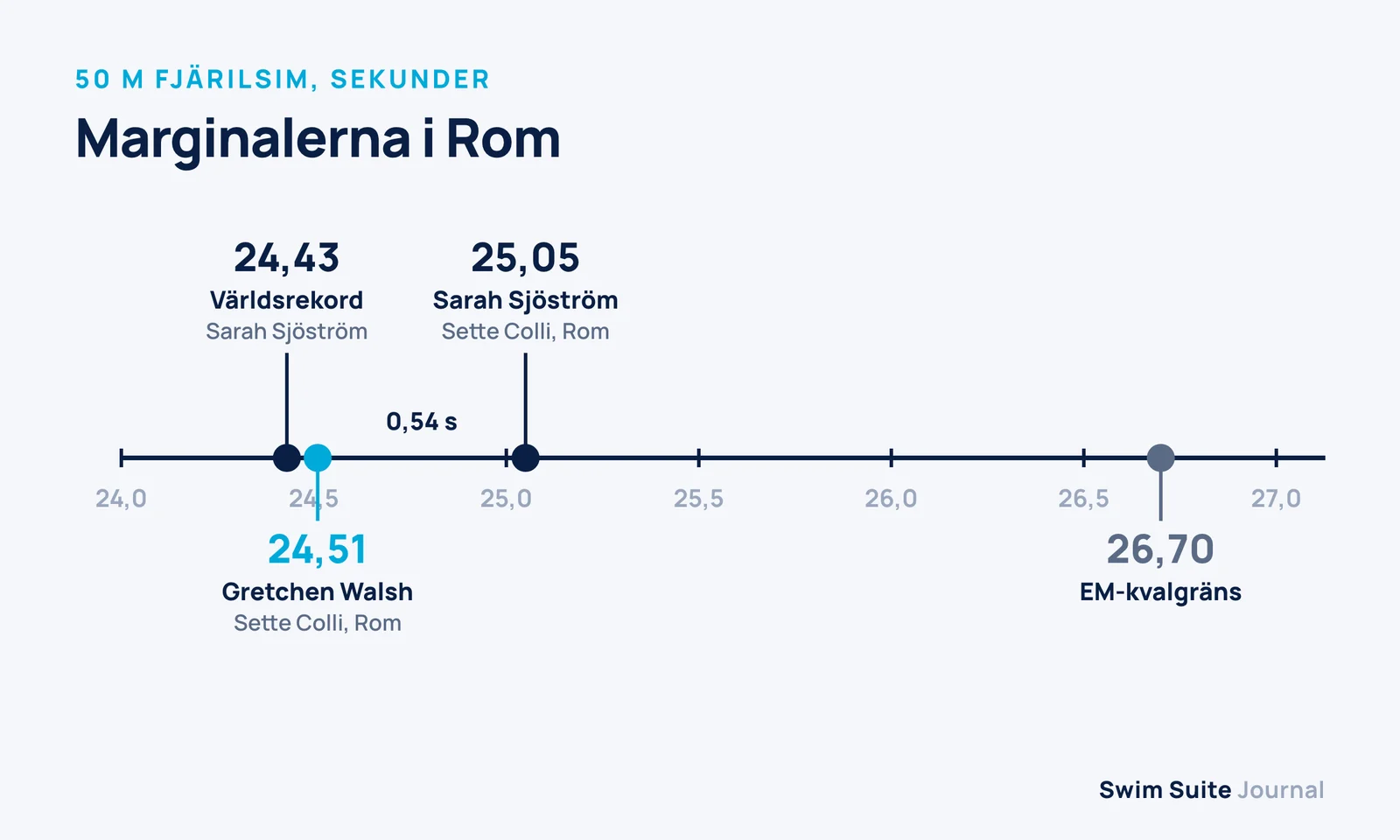
Sjöström clocked 25.05 in the 50 metres butterfly final. In almost any other era that time would have been untouchable, but the race also became a historic marker of the competition. American Gretchen Walsh thundered home in 24.51, the second-fastest time ever. Sjöström still holds the world record of 24.43, but Walsh's swim means she is being seriously challenged for the first time in a long while. That Sjöström is performing at this level so soon after her pregnancy is nothing short of a phenomenal show of strength ahead of the European Championships in Paris and the long road to the Olympic Games in Los Angeles.
I'm aiming for a double at the Europeans. Butterfly demands more of me than freestyle, but the goal all along has been to get back to the absolute top.
By clearing the European Championships qualifying time (26.70) with room to spare, Sjöström shows that the queen has no intention of giving up her throne without a fight.
The Swedish Championships in Borås: A Living Meeting Place for the Future
This year's Swedish Championships (SM) at Alidebergsbadet were more than a hunt for medals; they were a strategic win for Swedish swimming as an event. With 800 swimmers and more than 3,000 starts, the pressure was intense, but it was the setting that impressed most. Club director Jonas Söderberg and SK Elfsborg managed to turn the championships into a living meeting place.
By bringing in music, restaurant areas and education sessions, they created added value that reached far beyond the pool deck. This is the way forward for keeping people engaged in a sport that often struggles with long competition sessions.
The cornerstones of the festival atmosphere:
- Event area: a hub for socialising, with live music and a restaurant.
- Upskilling: lectures and coach education built into championship week.
- Club pride: Jonas Söderberg stresses how hosting at home creates pride and energy across the whole club.
A New Generation: When Talent Meets Tradition
We are now seeing the results of a deliberate investment in youth swimming. At SM in Borås, Sam Bengtsson Nimander wiped out the Swedish junior record in the 200 metres breaststroke with a time of 2:13.80. It is a time that promises international firepower, and the story of how he is following in the footsteps of his father, Anders Bengtsson, as a Swedish champion adds an extra dimension to the swim.
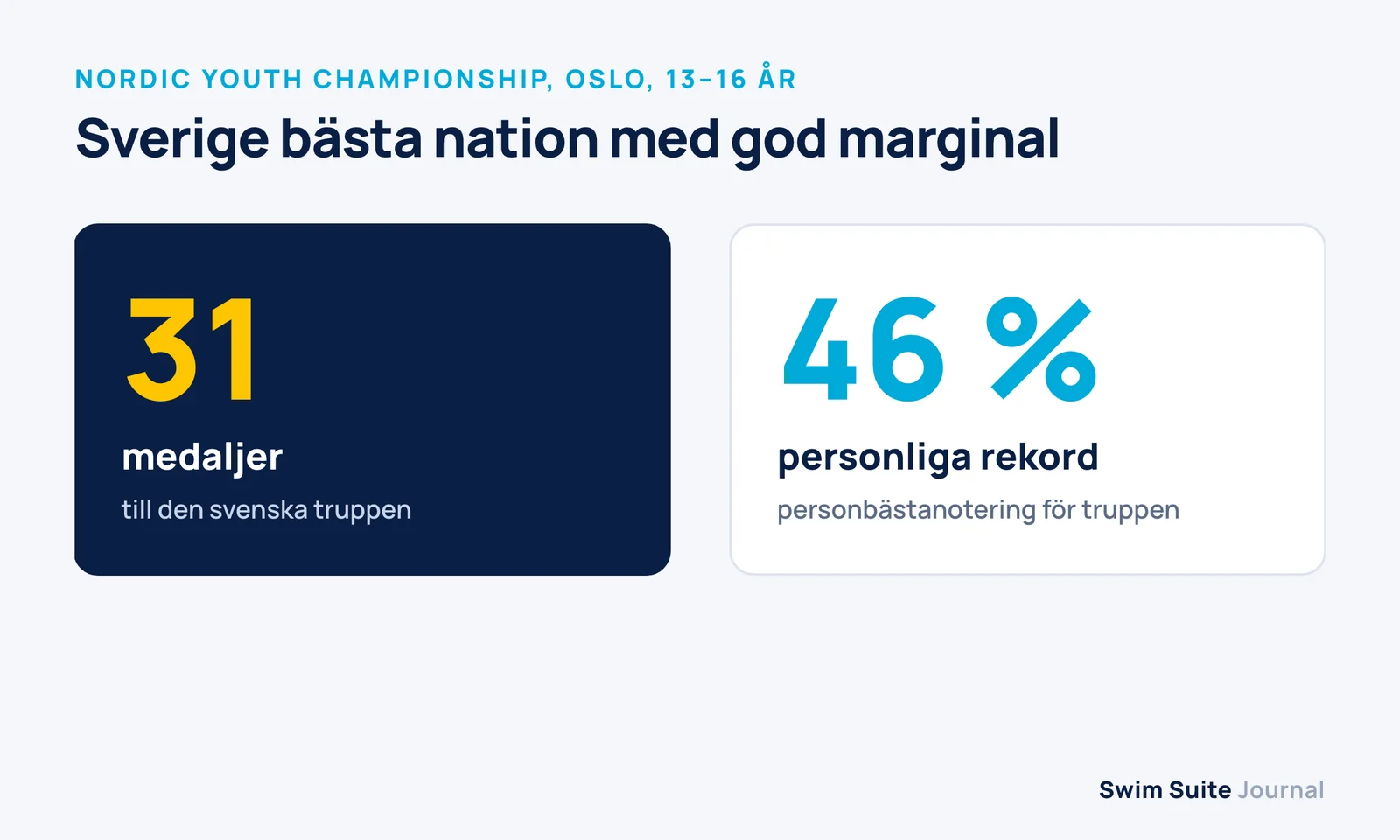
Meanwhile in Oslo, at the Nordic Youth Championship, the Swedish team (aged 13–16) dominated completely. With 31 medals and a personal-best rate of 46 per cent, the young swimmers showed textbook peaking. Finishing as the best nation in the Nordics by a clear margin is statistical proof that Sweden's depth at the top is growing.
Swedish Records Set at the 2026 Swedish Championships in Borås
| Event | Name / Club | Time | Record | Venue and date |
|---|---|---|---|---|
| 200 m breaststroke | Sam Bengtsson Nimander (Malmö KK) | 2:13.80 | Swedish junior record | Borås, 24 June |
| 4x100 m mixed freestyle relay | Ludvig Bartolek, Hanna Rosvall, Kasper Prahl, Hanna Bergman (Helsingborgs S) | 3:33.89 | Swedish record | Borås, June |
| 4x100 m mixed medley relay | August Mathisen, Hanna Rosvall, Louise Hansson, Ludvig Bartolek (Helsingborgs S) | 3:53.85 | Swedish record | Borås, June |
| 4x100 m women's medley relay | Hanna Bergman, Hanna Rosvall, Olivia Klint Ipsa, Louise Hansson (Helsingborgs S) | 4:03.53 | Swedish record | Borås, June |
The Million-Kronor Bet on Diving: Safety as a Technical Prerequisite
Swedish diving has received a substantial boost through a grant of just over four million kronor from the Swedish Inheritance Fund (Allmänna Arvsfonden). The project "Simhoppslinjen" (the Diving Pathway) tackles the sport's unique challenges: diving is a technically extremely demanding discipline in which the mental block is often the biggest obstacle.
The project focuses on building safe environments where children and young people dare to fail so that they can perform later on. Sofia Garametso stresses that this is about creating sustainable development pathways that suit the individual, not just the elite.
The project's priority areas:
- Coaching pedagogy: developing methods to ensure sound progression.
- Inclusive environments: new competition formats that lower the threshold for beginners.
- National collaboration: regional camps to spread specialist expertise.
Drama at the Finish: Why Precision, and the Gaps, Matter
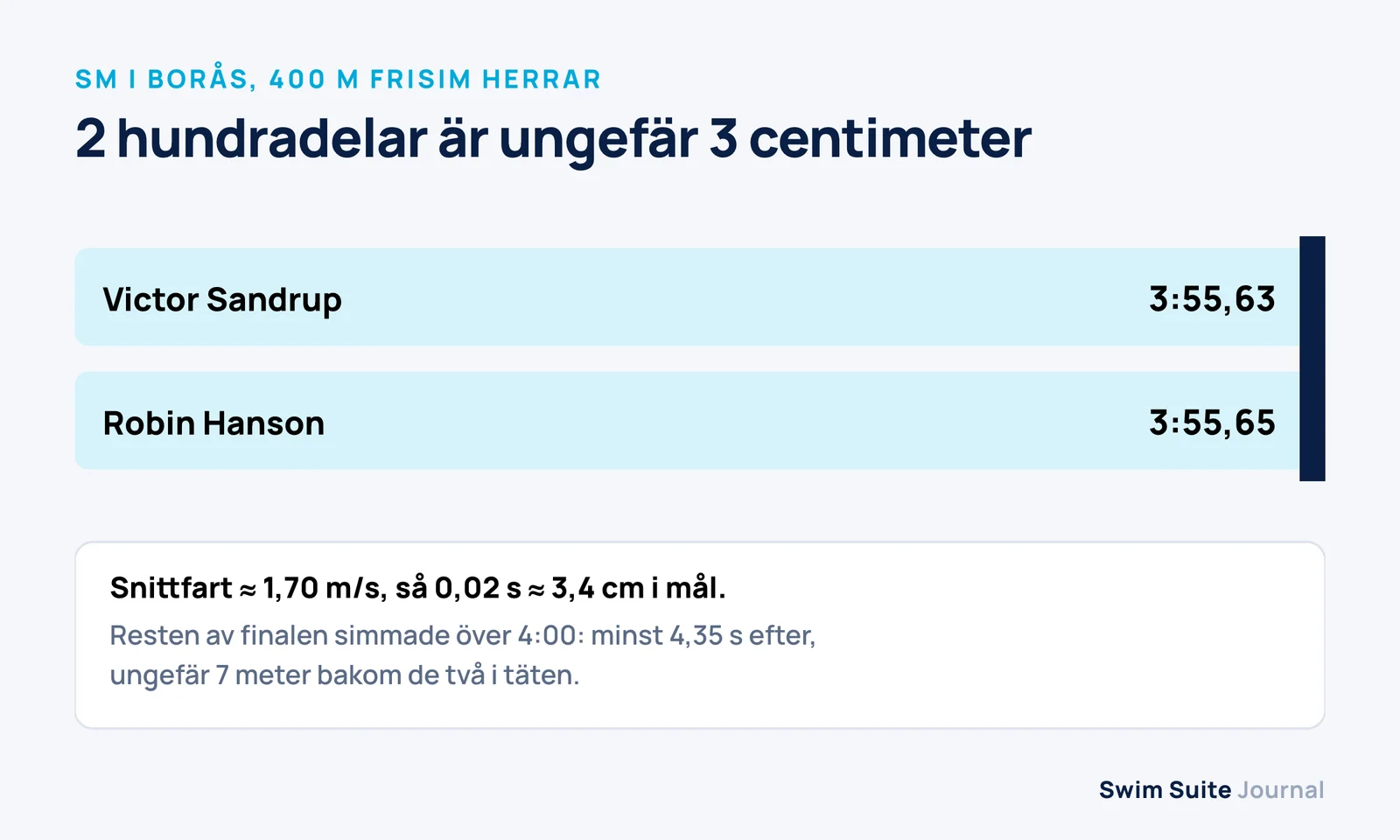
The first day of SM delivered a thriller in the men's 400 metres freestyle. Victor Sandrup and Robin Hanson fought a duel decided by a mere two hundredths of a second (3:55.63 against 3:55.65). It is in moments like these that swimming is at its most beautiful, when hundreds of hours of training come down to one last, decisive stroke.
With margins this small, the race is decided by things that can be measured: turns, underwater phases and stroke length. That is exactly what video analysis with Swim Analyzer breaks down, and we cover how to calculate stroke length in a separate article.
As an analyst, though, you have to sound a note of caution: behind these two, the gap was large. That the rest of the final swam times over 4 minutes is, as Bo Hultén has noted, "not all that impressive" for a national championship. It underlines the need to keep raising the middle tier of Swedish men's swimming to build broader international competitiveness.
Faith in the Future of Swedish Swimming
The past few weeks have been a showcase of the vitality of Swedish swimming. We see a world star in Sjöström defying the laws of nature, a Helsingborgs S demolishing relay records, and a youth generation that owns the Nordic stage.
With the new millions for diving and the growing focus on safety and the full experience at competitions, a platform is being built that is more sustainable than ever. The question is no longer whether Sweden can produce world-class swimmers, but how many of the talents we saw in Oslo and Borås will be standing on the podium in Los Angeles in 2028. The future looks bright, but now that energy has to be carried all the way to the wall.
That energy is carried through everyday training. Clubs that want to plan the season, track every swimmer's load and analyse technique in the same system can try Swim Suite free for 14 days. See plans and pricing.