
How to Calculate Stroke Length in Swimming
Stroke length is distance divided by stroke cycles — but the number only means something once you exclude the start and agree what counts as one stroke.
Also in Svenska
Stroke length is the distance a swimmer travels in one stroke, and it is calculated by dividing the distance swum by the number of strokes taken. A swimmer who covers 16 metres in 7 stroke cycles has a stroke length of 2.29 metres per cycle. The arithmetic is trivial. Almost every stroke length number quoted on a pool deck is still wrong, because of two decisions made before the division: what counted as a stroke, and which part of the length was measured. This article covers the formula, both of those decisions, and what to do with the number once you trust it.
What is stroke length?
Stroke length is the distance the body travels during one complete stroke cycle, usually written in metres per cycle. It is the same quantity coaches call distance per stroke, or DPS. Together with stroke rate — how many cycles are completed per minute — it fully describes swimming speed, because speed is the product of the two.
A swimmer gets faster in exactly two ways: by taking longer strokes, or by taking them more often. Every technical change a coach makes is one of those two, or a trade between them.
The stroke length formula
The calculation needs nothing more than a distance and a stroke count taken over that same distance, and it is identical for all four strokes:
Stroke length (m) = distance swum (m) ÷ number of stroke cycles
Stroke length is only half of swimming speed, though, and the second formula is the one that makes it useful. Velocity is the product of how long each stroke is and how often the strokes come:
Swimming velocity (m/s) = stroke length (m) × stroke rate (cycles/min) ÷ 60
The division by 60 converts stroke rate from cycles per minute, which is how it is normally reported, into cycles per second. Taken together the two formulas are also a self-check: measure all three quantities over the same section of pool and they have to agree with each other. When they do not, one of the three was measured wrong. The worked example below uses that check to confirm the section was timed correctly.
What counts as one stroke?
One stroke means one complete cycle, which in freestyle and backstroke is two arm actions, not one. This is the single most common source of stroke length numbers that cannot be compared with anyone else's.
| Stroke | One cycle is | Arm entries per cycle |
|---|---|---|
| Freestyle | Left arm and right arm | 2 |
| Backstroke | Left arm and right arm | 2 |
| Breaststroke | One pull and one kick | 1 |
| Butterfly | One pull and one kick | 1 |
A coach counting hand entries down a 25 metre freestyle length will say "eighteen strokes". A race analyst measuring the same length will say "nine cycles". The first produces a stroke length of about 1.2 m, the second about 2.4 m, and both are describing the same swim.
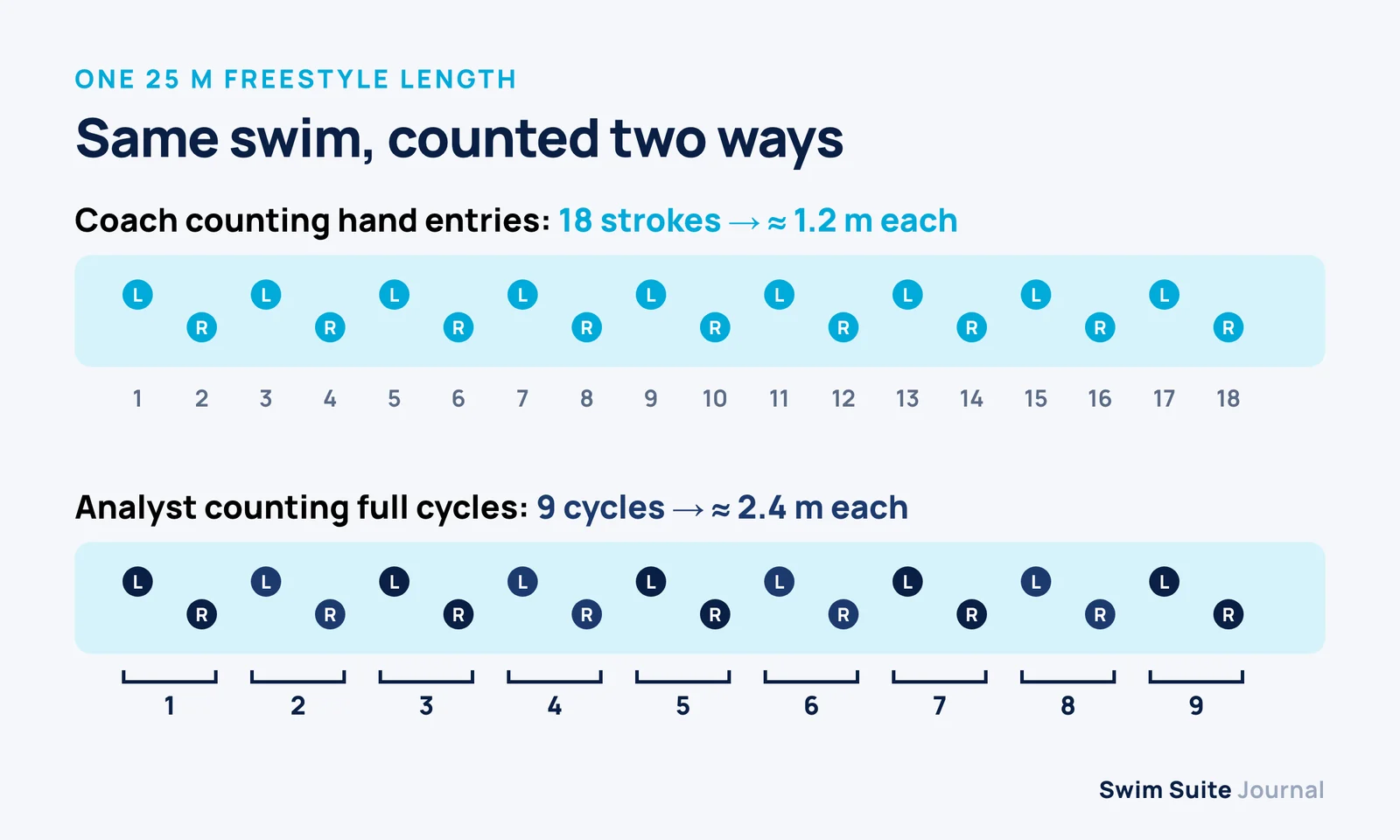
Neither is wrong. What is wrong is comparing one to the other, or to a published figure, without knowing which convention it used. Pick the cycle, because it is what the research and the velocity formula use, and state it whenever you write the number down.
Why you have to exclude the start and the breakout
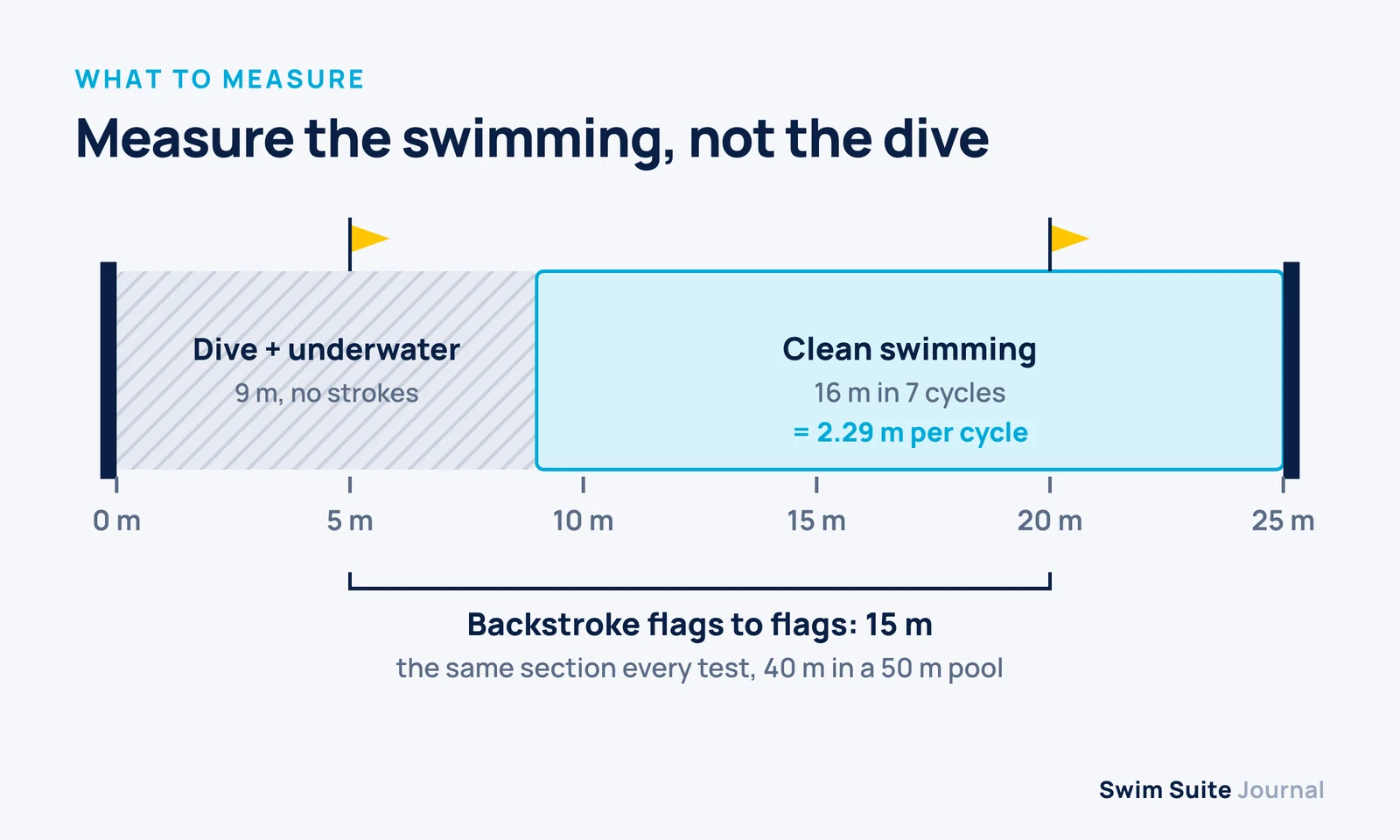
A dive and underwater breakout can cover 10 to 15 metres of a 25 metre length without a single arm stroke. Divide the full 25 metres by the strokes taken and you have credited the dive to the swimmer's stroke length.
This is why raw stroke counts flatter starts and turns. A swimmer who improves their underwater by two metres will show a longer stroke length on the naive calculation while their actual stroke has not changed at all.
Measure the clean swimming portion instead: the distance between the breakout and the wall, or better, a fixed section of the pool that excludes both ends. The backstroke flags are five metres from each wall in every pool, which makes flags to flags a convenient 15 metre section in a 25 metre pool and 40 metres in a 50 metre pool. Same markers every time, no tape measure.
Worked example: a 50 m freestyle, calculated two ways
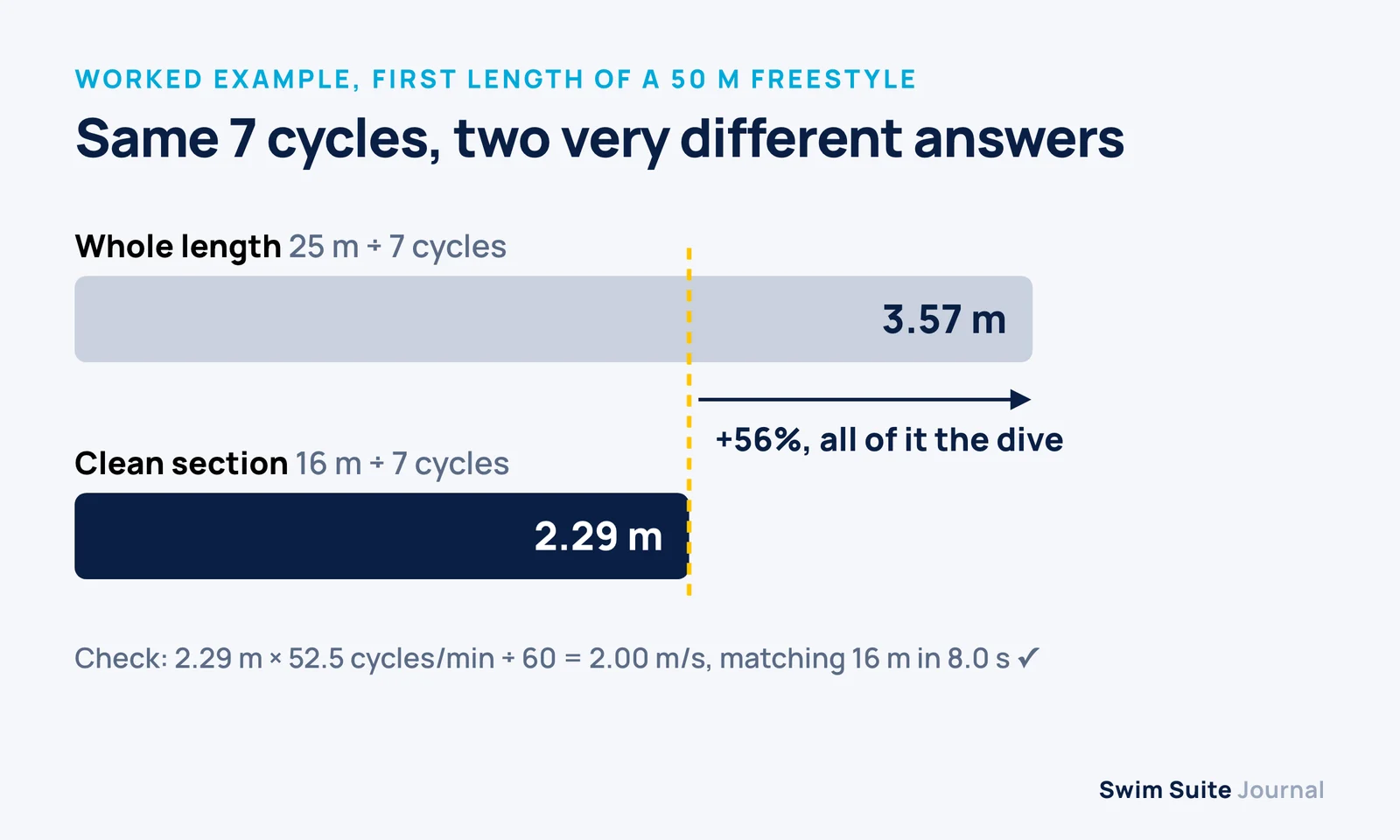
A swimmer opens a short course 50 m freestyle. On the first length they break out at the 9 metre mark, touch the far wall at 25 metres, and take 14 arm entries — 7 full cycles — in between. The clean swimming section took 8.0 seconds.
Calculated the naive way, using the full length of the pool, the swimmer appears to cover 25 metres in 7 cycles:
- 25 m ÷ 7 cycles = 3.57 m per cycle
Calculated the clean way, counting only the part of the length the swimmer actually swam, the distance drops to 16 metres for the same 7 cycles:
- 25 m − 9 m = 16 m of clean swimming
- 16 m ÷ 7 cycles = 2.29 m per cycle
The first number is inflated by 56%, and all of it is the dive. Now check the clean number against the velocity formula:
- Velocity: 16 m ÷ 8.0 s = 2.00 m/s
- Stroke rate: 7 cycles ÷ 8.0 s = 0.875 cycles/s = 52.5 cycles/min
- Check: 2.29 m × 52.5 ÷ 60 = 2.00 m/s ✓
The three numbers agree, which means the section was measured consistently. When they do not agree, the usual culprit is a stroke counted at the wall that happened after the timing stopped.
What is a good stroke length?
A good stroke length is the one that produces your fastest velocity, which is not the longest one you can achieve. Stroke length and stroke rate trade against each other, and the fastest swim is a specific point in that trade, not either extreme.
Here is the same swimmer, in the same event, at five different stroke rates:
| Stroke rate (cycles/min) | Stroke length (m) | Velocity (m/s) | 50 m time |
|---|---|---|---|
| 44 | 2.50 | 1.83 | 27.3 s |
| 48 | 2.45 | 1.96 | 25.5 s |
| 52 | 2.35 | 2.04 | 24.5 s |
| 56 | 2.15 | 2.01 | 24.9 s |
| 60 | 1.90 | 1.90 | 26.3 s |
The row with the longest stroke is the slowest row in the table. Below 52 cycles per minute this swimmer holds their stroke length almost perfectly, so every increase in rate is a free gain in speed. Above 52 their stroke length collapses faster than the rate climbs, and the speed goes with it.
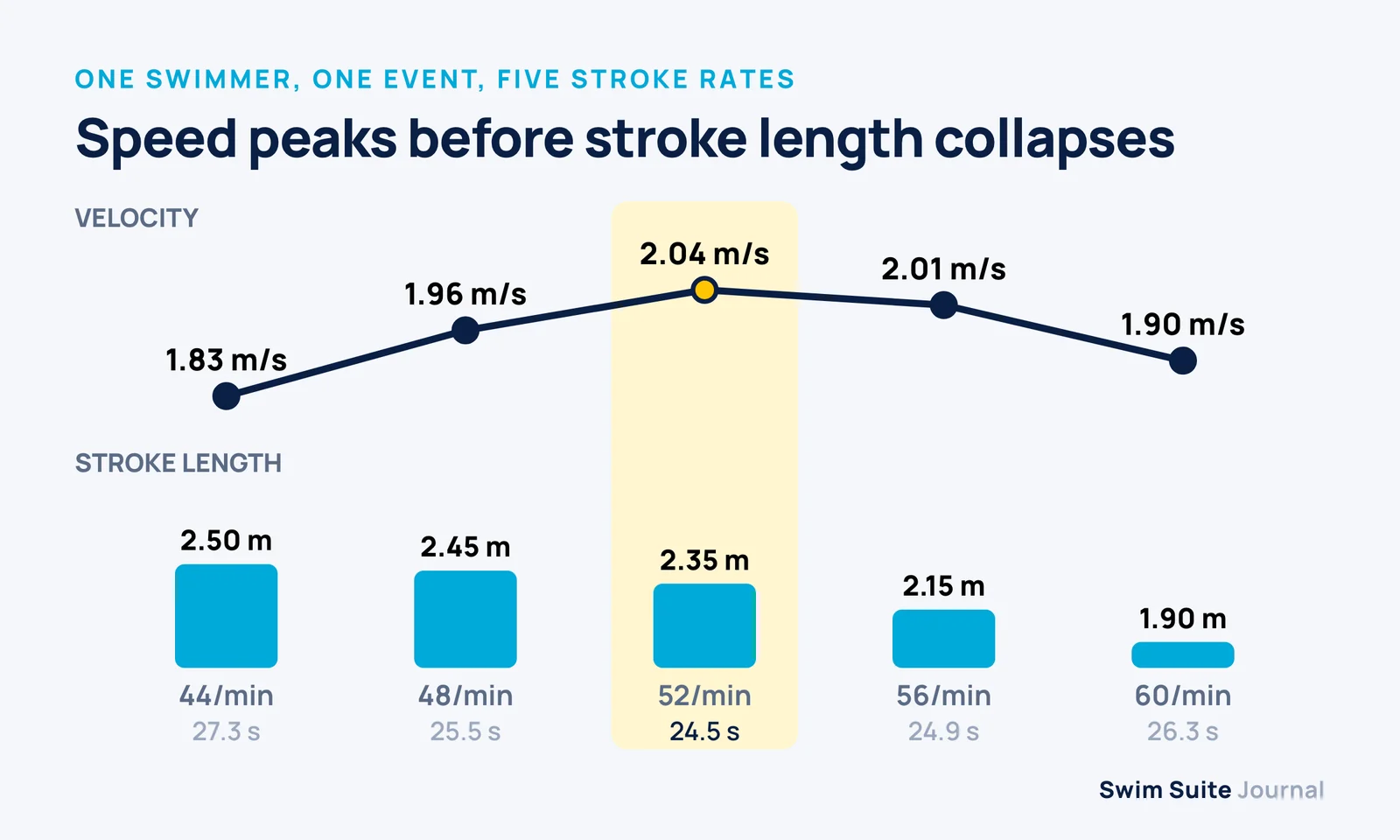
That inflection is the number worth knowing about a swimmer. It is individual, it differs between events, and it moves as they train.
As orientation only: international 100 m freestyle finalists typically swim at roughly 2.2 to 2.5 metres per cycle for men and 2.0 to 2.2 for women, at stroke rates around 50 to 55 cycles per minute. Treat those as a sense of scale rather than a target. Stroke length scales with height and arm span, so a 1.70 m swimmer matching a 1.95 m swimmer's stroke length is not a goal, and would probably be a mistake.
Stroke length versus stroke rate: which one to change
Compare the swimmer against themselves over a race, not against a benchmark.
- Stroke length falls in the back half, rate holds or rises. This is fatigue in the pull, and it is the most common pattern. The swimmer is working harder to go slower. Aerobic and strength work, not technique cues.
- Stroke length holds, rate falls. Pacing or turn quality, usually, rather than the stroke itself. Look at the splits and the walls first.
- Stroke length is long and rate is low, and the swim is slow. The swimmer is gliding. They are optimising the number instead of the swim, which is what happens when stroke count is coached as a target in its own right.
- Rate is high and stroke length is short from the first length. Often a timing problem — the pull starts before the body has a position to pull against.
The diagnosis comes from the pair. Either number alone will mislead you, which is why measuring stroke length without stroke rate is rarely worth the effort.
How to improve stroke length
Real gains come from holding a longer stroke at race speed, not from swimming slowly with an exaggerated glide:
- Swim stroke-count sets at a fixed pace, not at any pace. Descending 50s on a set stroke count teaches speed at that length. Counting strokes on easy swimming teaches gliding.
- Fix the catch before anything else. Most short strokes are a hand slipping at the front, not a short finish.
- Train it at the rates you race at. A stroke length that only exists at 40 cycles per minute does not appear in a race.
- Measure the same section every time. Flags to flags, every test, or your improvements are measurement noise.
Those sets belong in the training plan rather than in a coach's head. Put them in the race-pace blocks of the season, as you would in a season plan in Swim Suite, and the test repeats on schedule instead of whenever someone remembers. With the session in Swim Forge, the swimmer sees the target stroke count before they get in the water.
Common mistakes
- Counting hand entries but calling them cycles, which halves the stroke length you end up with.
- Including the dive or the push-off in the distance.
- Comparing short course and long course figures — the short course number carries more turns and more underwater per length.
- Treating a lower stroke count as an improvement when the swim got slower.
- Measuring once. Stroke length varies length to length; take at least three and average.
How Swim Analyzer measures it
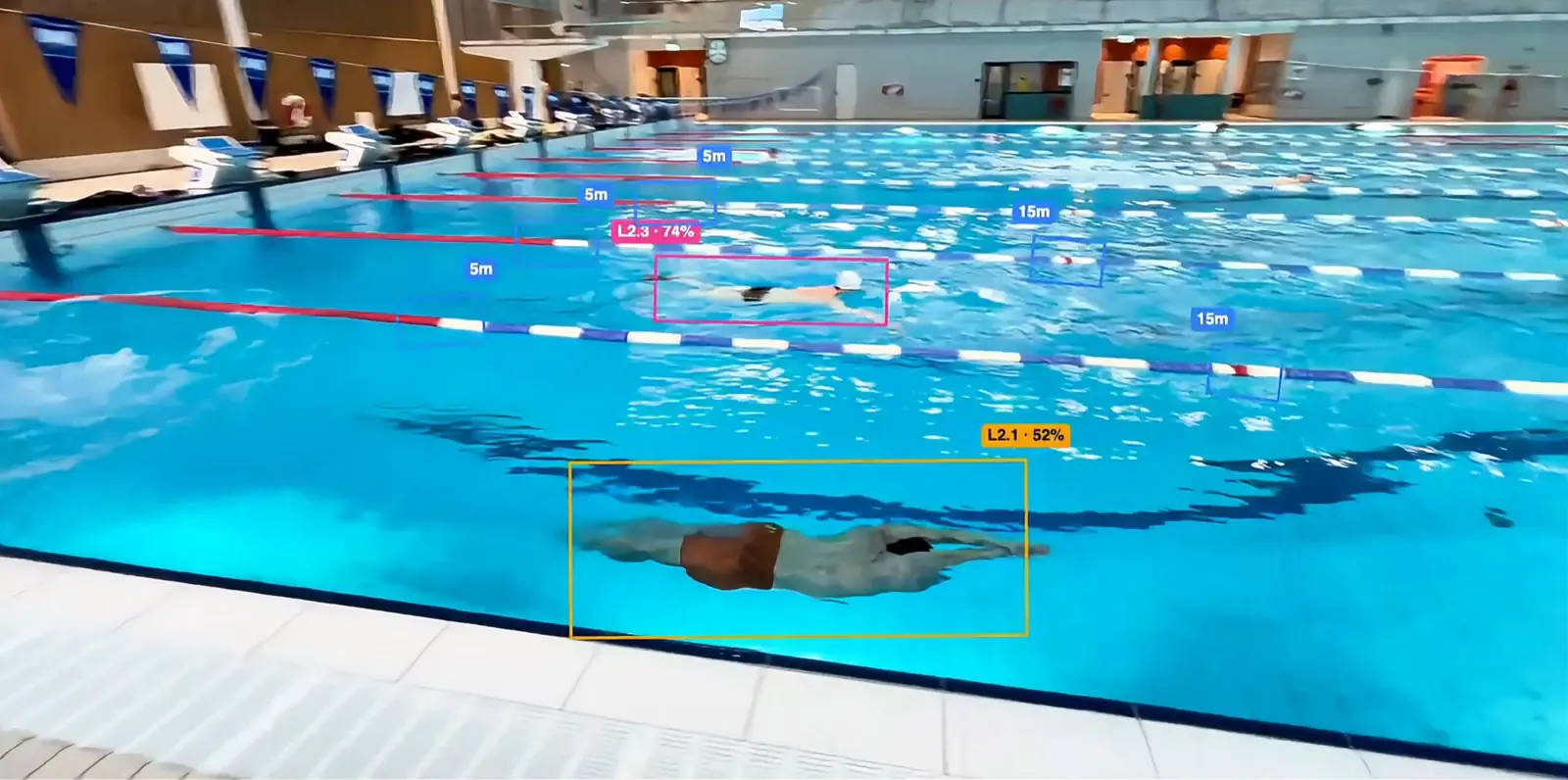
Swim Analyzer takes stroke length off a phone clip rather than a clipboard. The pose model locates the pool walls in the footage and places the distance guides from that geometry, so the breakout is detected rather than eyeballed, and the clean swimming section is the same section every time. Stroke rate and velocity are measured from the same clip, which means the three numbers are consistent by construction and the check in the worked example above never has to be done by hand.
Why detection matters more than a faster stopwatch is the subject of automatic swim race analysis, and the full set of measurements from block to touch is in the swimming software that measures the swimming. Swim Analyzer Pro is included in every Swim Suite plan; see plans and pricing. For where video analysis sits next to planning and team software, see the five types of swim software.
Is stroke length the same as distance per stroke?
Yes. Distance per stroke, DPS and stroke length are three names for the same measurement, and all three are usually reported in metres per stroke cycle.
Does a longer stroke always mean faster swimming?
No. A longer stroke is only faster if it is achieved without giving up more stroke rate than it gains. Deliberately reducing stroke rate to lengthen the stroke usually lowers velocity, as the first row of the trade-off table above shows.
How many strokes should a 25 m length take?
There is no correct number, because it depends on height, event, speed and how far the swimmer travels underwater. A useful reference point is a well-trained senior freestyler covering a 25 metre length in roughly 8 to 11 cycles including the push-off. The figure worth tracking is not the count itself but whether it holds at race pace from the first length to the last.