
The swimming software that measures the swimming
Also in Svenska · Deutsch · Español · Français · Italiano · Nederlands · Norsk · Dansk · Suomi
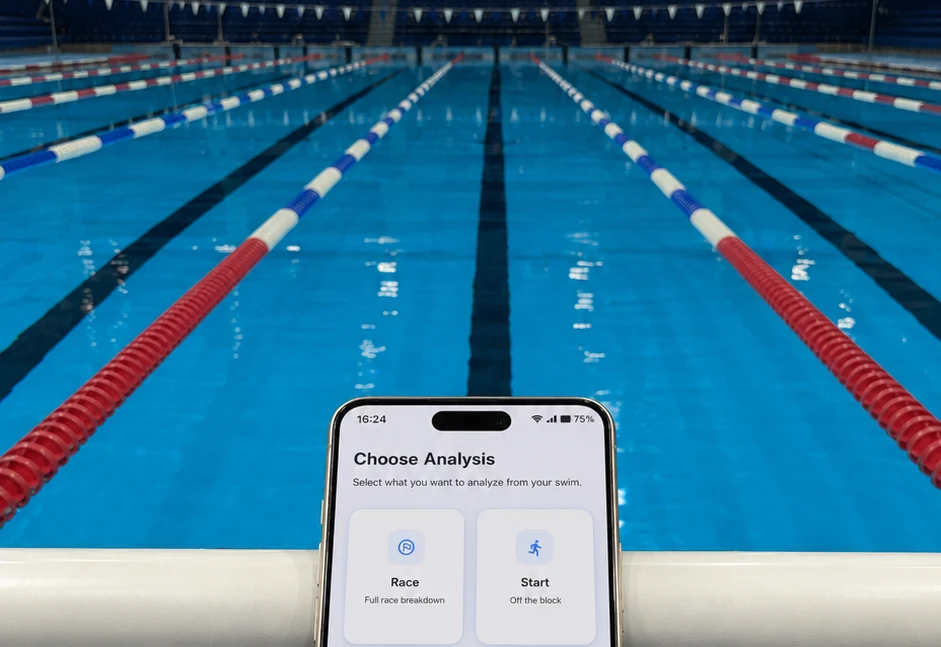
Every club already owns software that counts. Swim Analyzer is the one that looks. It turns a phone clip into reaction time, entry angle, breakout distance and stroke length, on the pool deck, with the pose model running on the handset.
Search for swimming software and you get entry systems, meet managers, timing consoles and club administration. All of it necessary. None of it about swimming. It records that a swimmer went 26.41, and stops where the interesting question starts, which is why 26.41.
That question has always had an answer. It lives in the video. Coaches have been scrubbing frame by frame with a fingertip on a phone screen for fifteen years, counting strokes out loud, guessing at the breakout because the lane rope markers are the only ruler in the building. The analysis was never impossible. It was just expensive in the one currency a coach never has, which is minutes on the pool deck.
Swim Analyzer lowers that cost. You film a swim on the phone already in your pocket. You mark the reference points the app asks for. It returns a measured breakdown of the race, block to touch, before the swimmer has finished their warm down.
Block to touch, measured in five phases
A race is a sequence, so the analysis is too. Each phase is its own tool inside the app, and each one produces numbers a coach can use the same session.
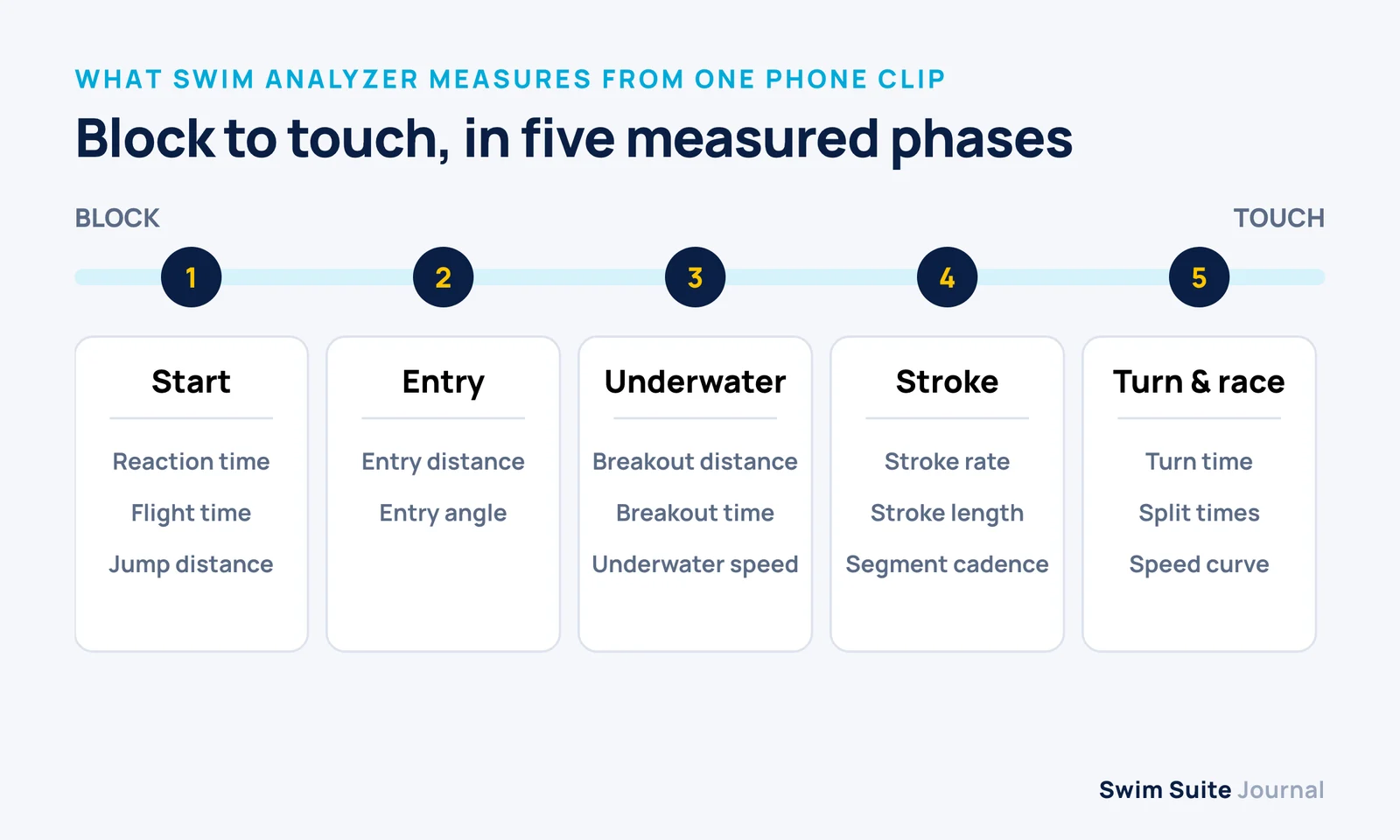
- The start. Track, grab or relay. The start kind is part of the record, so a swimmer's numbers are only ever compared against the same movement. Measures reaction time, flight time, jump distance, start kind.
- Entry. Where the hands break the surface and at what angle. These are the two variables that decide how much of the dive's speed survives the water. Measures entry distance, entry angle.
- Underwater and breakout. The most valuable and least measured stretch of any race. Distance and time to breakout, plus the velocity you actually carried there. Measures breakout distance, breakout time, underwater velocity.
- Stroke. Stroke rate and stroke length together, over the segments you choose. One without the other has been misleading swimmers for decades. Measures stroke rate, stroke length, segment cadence.
- Turn and race overview. Turn time in and out of the wall, then every split assembled into one race view with a speed curve across the whole swim. Measures turn time, split times, speed graph.
Nothing here is a new idea. It is the analysis elite programmes have run in biomechanics labs for thirty years, delivered on a phone at a Tuesday night club session.
The model runs on the phone
Most video analysis products are a thin client in front of a server. Upload the clip, wait, download the result. That works in an office and not in the place where the work happens: a tiled hall with concrete walls, a saturated guest network and a coach who has four minutes between heats.
Swim Analyzer takes the pose model trained in our own ML studio, exports it, and runs it on the handset. Core ML on iPhone, LiteRT on Android. It samples frames from your clip, finds the pool walls, and lays measurement guides over the video without a single byte leaving the device.
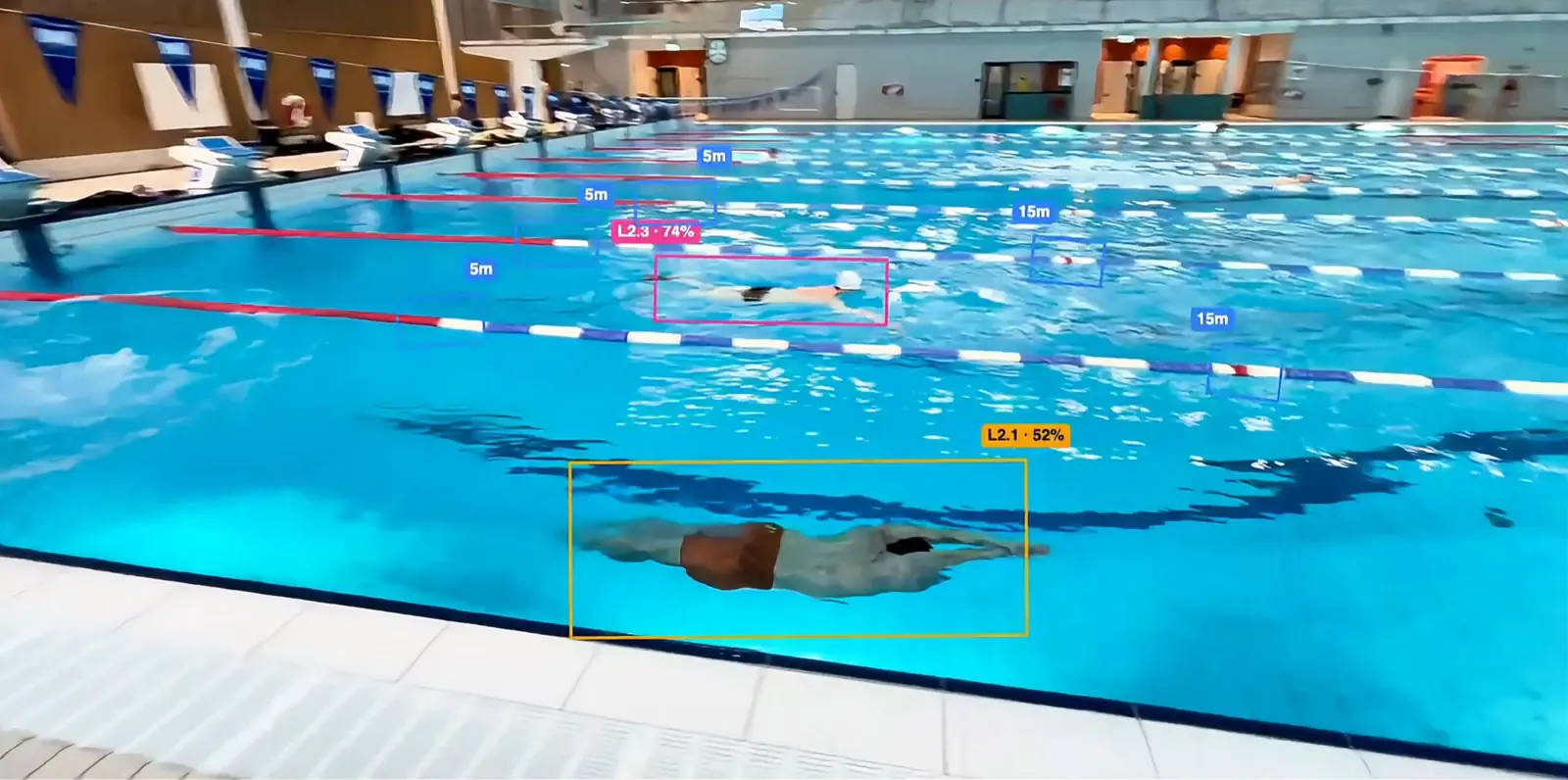
Why that matters. No upload queue, no round trip, no wifi. Analysis works in a basement pool, on an away trip, on a plane home from a meet. The clip does not leave the phone to be measured.
It is also the same maths. The geometry that runs on the device is a direct port of the geometry that runs on the server, so a guide drawn on the deck matches the one the backend would have drawn. Offline is not the degraded mode. It is the mode.
The app is honest about confidence. When the model is not sure it has found the walls, guides are withheld rather than drawn wrong. Enrichment, never a promise. A tool that hands a coach a confident number it cannot support does more damage than one that says nothing.
One loop, from clip to coaching point
Numbers on a screen change nothing on their own. What changes a swimmer is the loop that closes around them, and Swim Analyzer ships the whole loop rather than a measuring tool with the rest left as an exercise.
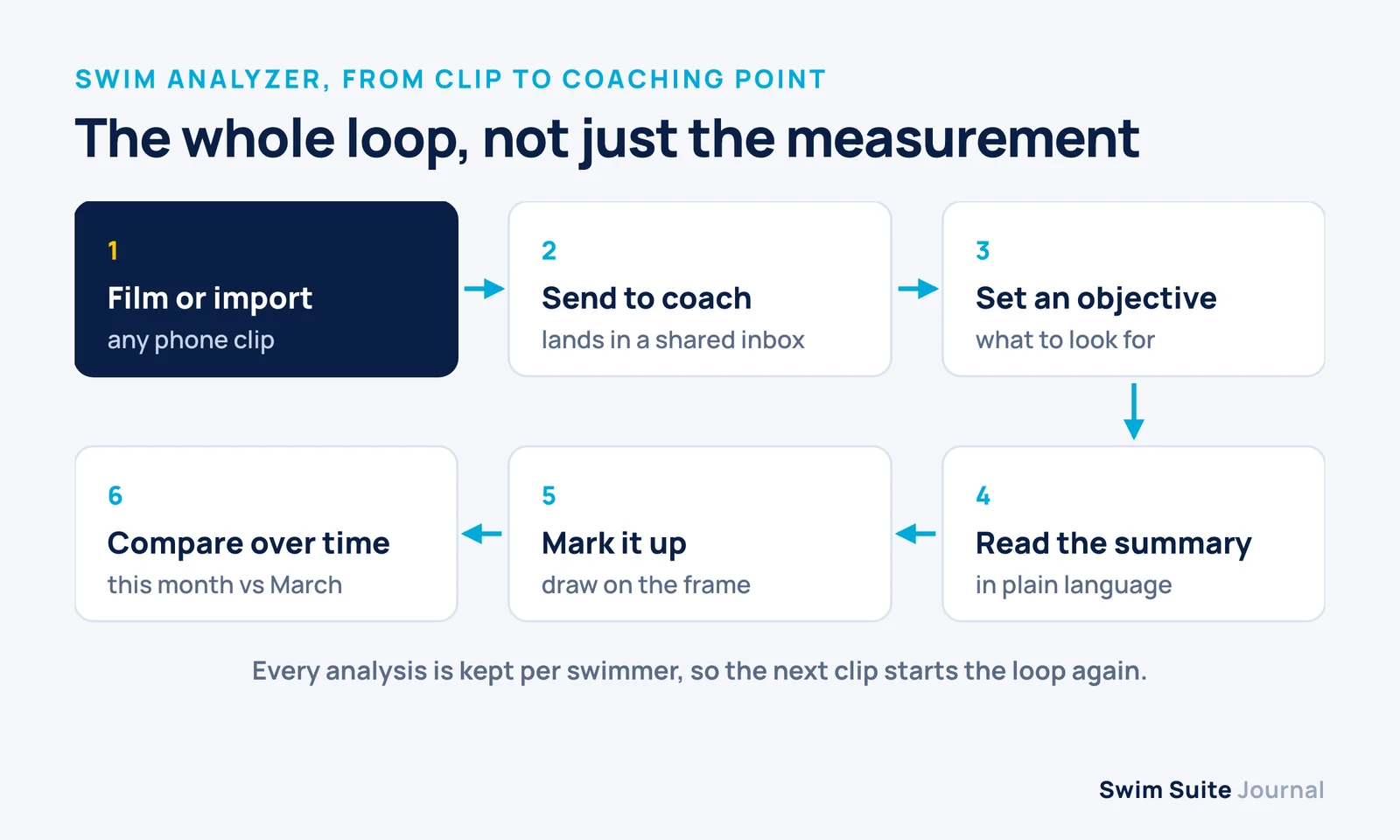
Film or import. Any phone clip. The app reads frame rate and capture date off the file, so timings are computed against what the camera actually recorded and not against an assumption.
Send for analysis. A swimmer sends a swim to their coach and it lands in a shared inbox instead of a group chat where it will be scrolled past by Thursday.
Set an objective. Coaches attach technique objectives to sessions, and each swimmer sees the ones aimed at them. The analysis opens already knowing what it is supposed to be looking for.
Read the interpretation. Alongside the raw table there is a written summary of your actual measurements, in plain language, for the swimmer who does not yet think in metres per second.
Mark it up. Quick analysis with telestration lets you draw straight onto the frame, screenshot it and send it. The oldest coaching tool there is, applied to new data.
Compare over time. Every analysis is kept per swimmer, so this month's breakout sits next to March's.
A monthly leaderboard, free for everyone
Swimming's motivational problem is that the season is long and meets are rare. So Swim Analyzer carries a monthly leaderboard, open to every swimmer on the app at no cost, ranked on measured starts and races from swims filmed that month.
It is built deliberately. You post under a nickname, not your legal name. Boards are scoped by pool length, so 25 m and 50 m and yards are never silently mixed. You always see your exact placing, for example 3 of 312, without the app handing out anyone else's raw metrics. Leaving deletes every entry you ever posted and releases your handle. A real withdrawal, not a hidden flag.
Who it is for
Club coaches who want one measured start per swimmer per month instead of one lab session per squad per year. Age group programmes where technique debt compounds and nobody has time to catch it. Individual swimmers and masters with no coach on the deck and a phone on a tripod. Analysts who want structured, exportable numbers rather than a folder of video. Why that changes who gets analysed at a club is argued in automatic swim race analysis.

Team seats are managed in Swim Suite, so a club buys once and every swimmer and coach is covered. See plans and pricing for what each club size costs.
Questions coaches ask first
How is this different from meet management swimming software? Meet management software runs the competition: entries, heats, results, timing. Swim Analyzer analyses what happened inside those results. Most clubs use both. One scores the meet, one works out where the tenths went.
Do I need underwater cameras or special equipment? No. A phone, and ideally something to hold it steady. The app is built around the footage clubs can actually get from the side of the pool.
Does swim analysis work without internet at the pool? Yes. The pose model runs on the phone itself, using Core ML on iOS and LiteRT on Android, so wall detection and measurement guides work fully offline. Pool wifi is not a prerequisite for getting a result.
Which parts of a swim can it analyse? Starts, strokes, turns and full races, each as its own tool. Together they cover a swim from the block to the touch, with a speed curve across the whole thing.
Can swimmers send video to their coach through the app? Yes. Swimmers send a swim for analysis and it arrives in the coach's inbox, tied to a swimmer profile and, where one exists, to the technique objective it was filmed for.
Is it for clubs, or can an individual swimmer use it? Both. Individuals subscribe directly. Clubs buy team seats through Swim Suite, which covers every swimmer and coach on the roster. The monthly leaderboard is free either way.