
Swim Club Management Software: How to Choose One
Swim club management software is two kinds of system: admin and coaching. What each covers, what to look for, real pricing, and where Swim Suite fits.
Also in Svenska
What Is Swim Club Management Software?
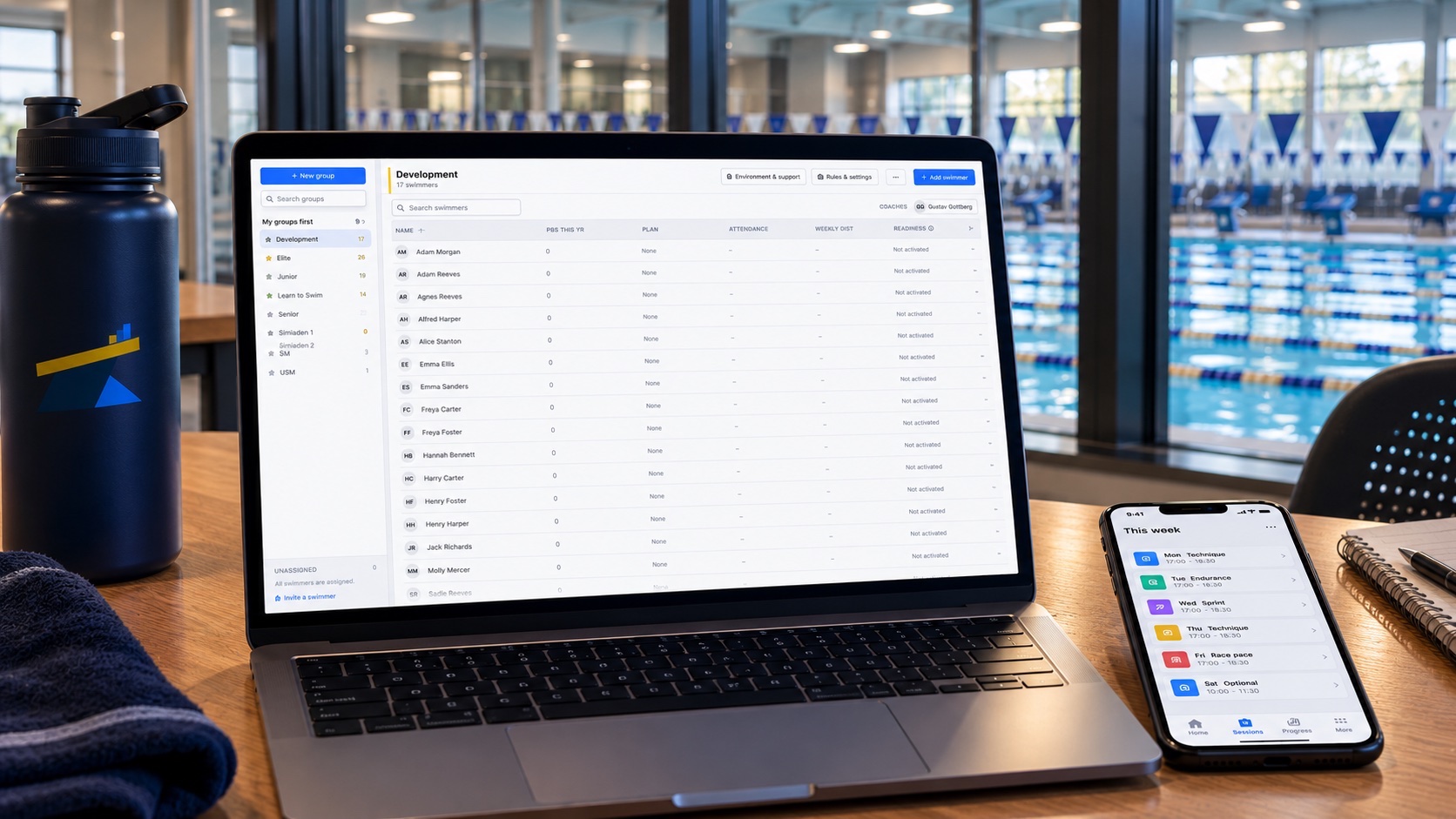
Swim club management software is the system a club uses to run its swimmers, groups, coaches and season in one place instead of across spreadsheets, group chats and shared folders. In practice the phrase covers two different jobs, and most of the confusion when choosing a system comes from mixing them up.
The first job is administration: membership, fees, registration, lesson booking and accounting. The second is the sporting side: training groups, coaches, season plans, attendance, competitions and how each swimmer develops. A swim school selling lessons to the public lives mostly in the first. A competitive club lives mostly in the second, because that is where its coaches spend their week.
Two Kinds of Swim Club Management System
Before comparing feature lists, decide which of these two columns holds your club's actual problem.
| Compared on | Administration systems | Coaching and team systems |
|---|---|---|
| Core record | The member and their payments | The swimmer and their training |
| Typical features | Registration, fees, invoicing, lesson booking, accounting exports | Groups, season planning, sessions, attendance, competitions, swimmer history |
| Main users | Treasurer, office, board | Head coach, group coaches, swimmers, parents |
| What it replaces | Paper forms, bank transfers, booking spreadsheets | Training spreadsheets, Word documents, group chats |
| Question it answers | Who has paid? | What did this group actually train, and is it working? |
Some products try to cover both columns, usually by being strong in one and thin in the other. Many clubs already handle membership and fees through their federation or a general sports-club platform. What those clubs are missing is rarely a second membership database. It is the coaching side that a general platform was never built for, which is why the search for club software so often ends with the coaches still working in spreadsheets.
Why Spreadsheets Stop Working
A spreadsheet is a perfectly good swimming club database for one coach and one group. It breaks when the same information has to live in several places at once and nobody owns the copy that is correct.
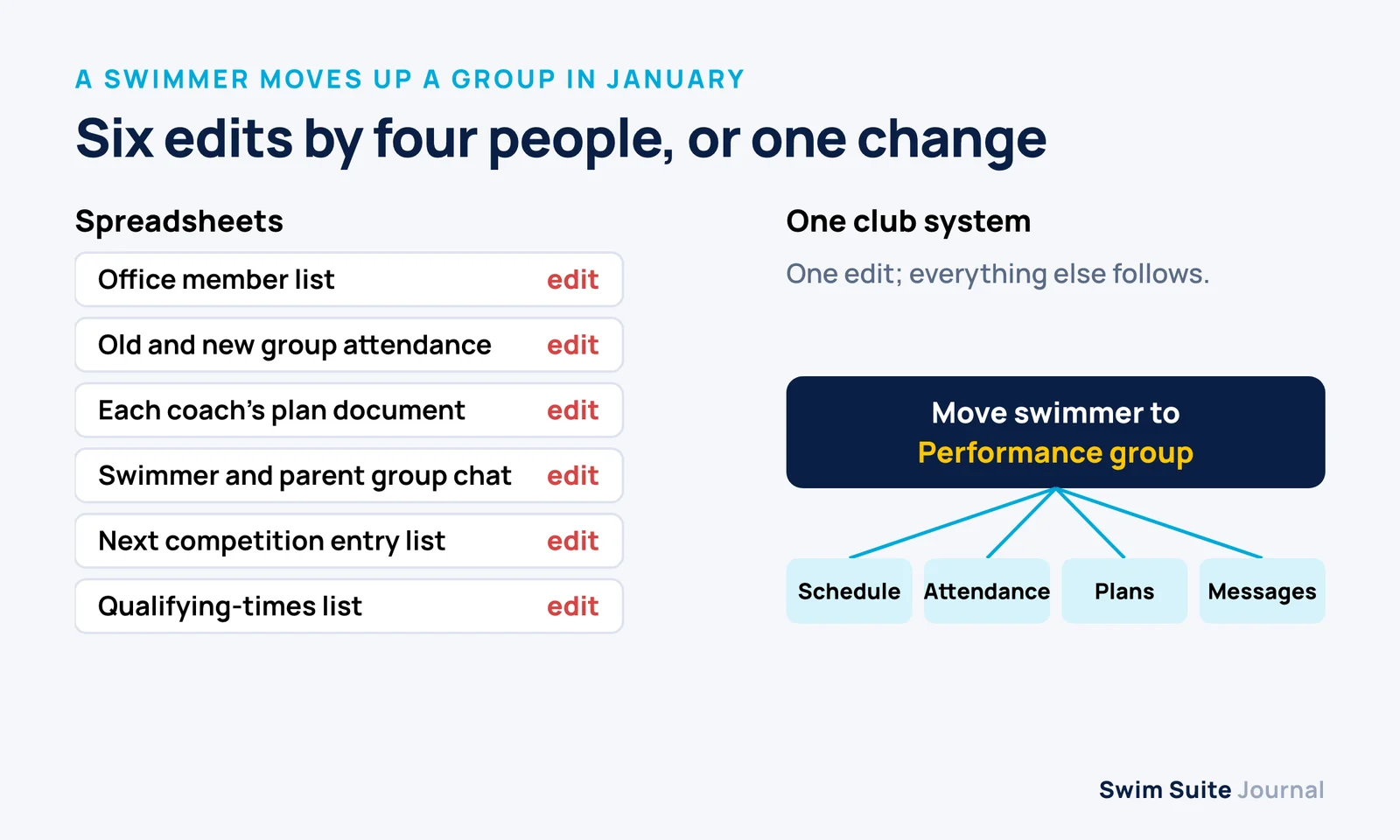
Take a single, ordinary change: a swimmer moves up from the development group to the performance group in January. In a typical spreadsheet setup that one decision has to be repeated in:
- The member list the office keeps
- The attendance sheet for the old group, and the one for the new group
- Each group coach's training plan document
- The group chat for swimmers and parents
- The entry list for the next competition
- The qualifying-times list the head coach checks before championships
That is six edits by up to four different people. Miss one and the swimmer turns up at the wrong session, a parent follows the old schedule, or the training history splits in two so nobody can later see the swimmer's full season. In a team management system it is one change: move the swimmer to the new group, and the schedule, attendance, plans and messages follow.
What to Look For in Swim Team Management Software
Seven things separate a system coaches keep using from one they abandon by November. None of them is a long feature list; each is about whether the software fits how a swimming club is actually organised and run week to week.
Groups and Roles That Match Your Club
Clubs are organised as groups with a responsible coach, assistants, swimmers and parents. The software should model that directly: a group coach sees their own groups, the head coach sees all of them, and a parent sees their own child. A system where everyone sees everything, or nothing, does not survive its first season.
Season Planning, Not Just a Calendar
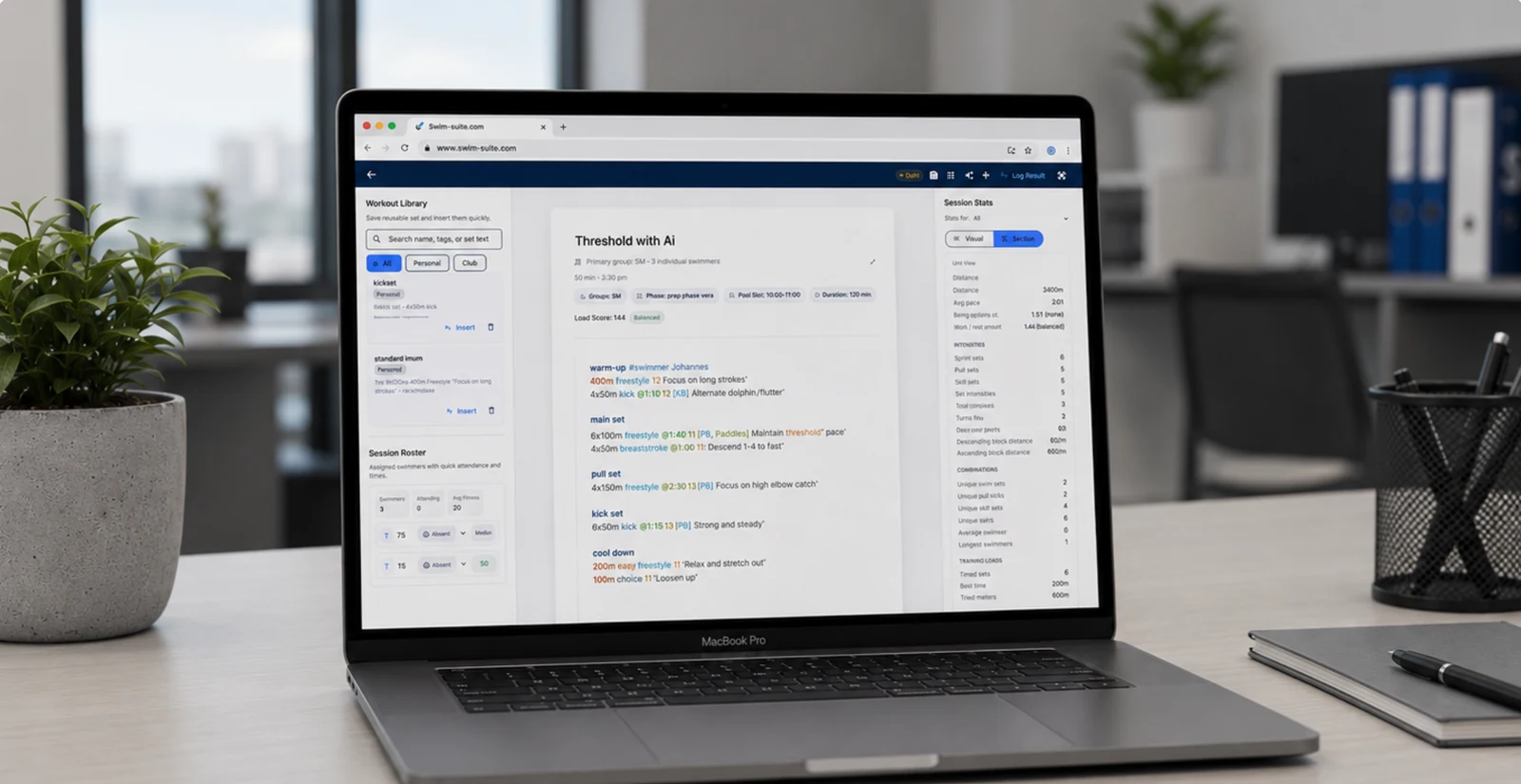
A calendar tells you when training happens. Swimming-specific software should also hold what the training is: the season plan, training blocks, weekly load and the sets themselves. This is the clearest line between generic sports software and a system built for swimming, where distances, strokes, intervals and intensity are the actual content of the work.
Attendance Connected to the Plan
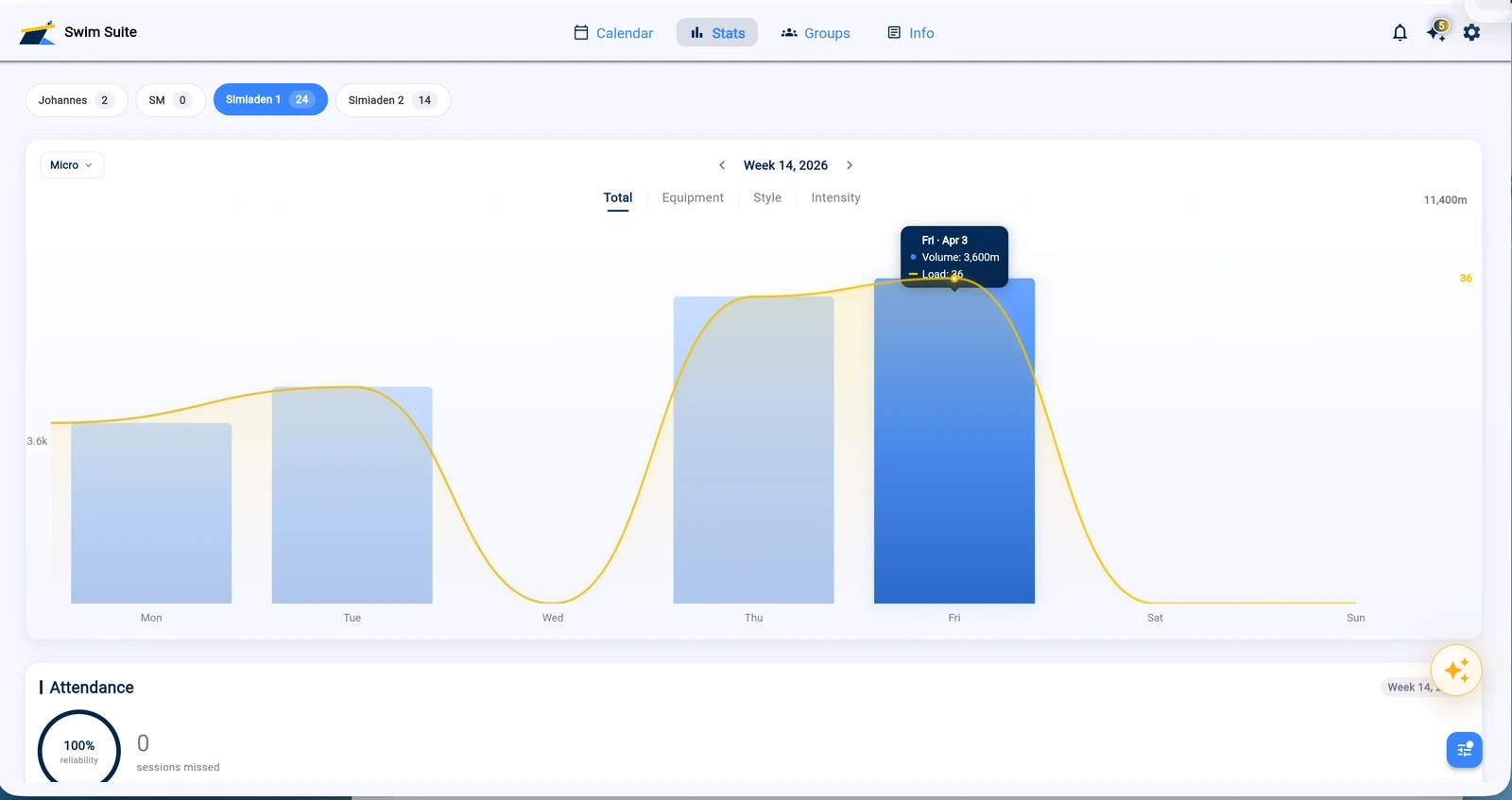
Attendance is only useful if it can be compared with what was planned. Look for a system where planned and completed training live together, so a coach can see each swimmer's real weekly load rather than a list of ticks that never gets read again.
Competitions and Qualifying Times
A competitive club plans its season backwards from its meets. The software should let coaches place competitions in the season plan, see which swimmers are going, and track each swimmer against the qualifying times for the championships the group is aiming at.
Communication That Stays With the Club
Messages, documents and schedule changes should reach the right group, and parents should get the logistics without needing a coach's private phone number. When communication runs through the club's system, it stays with the club when a coach leaves.
A Way In for Swimmers
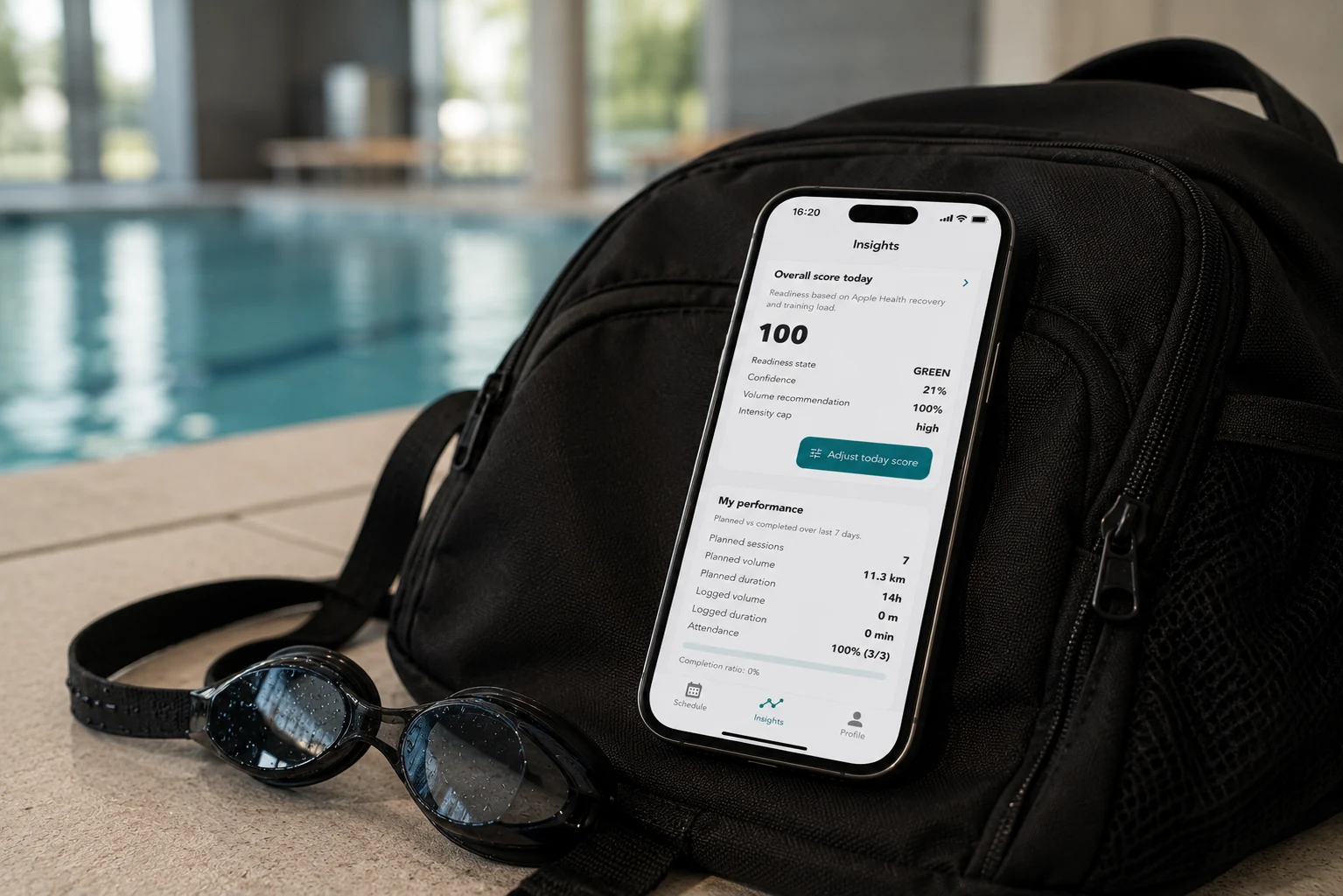
If swimmers cannot see their own sessions and targets, the coach becomes the relay for every question. A swimmer app connected to the coach's plan removes that, and gives the coach feedback on how training actually felt.
Import From What You Already Have
No club starts from zero. The system should import your roster from a spreadsheet, CSV or Excel, so setup takes an afternoon rather than a season. A system that expects every swimmer to be typed in by hand is telling you how the rest of the relationship will go.
Questions to Ask Before You Choose
Feature lists from different vendors tend to look alike. Ask these questions in a demo or during a trial instead; the answers show the differences that matter once the first month is over.
| Question | Why it matters |
|---|---|
| Who enters the data, and how long does it take each week? | Software that adds admin to coaches gets abandoned. |
| Can a coach be limited to their own groups? | Roles decide whether the head coach can trust the overview. |
| What can parents see, and who decides? | Parents need logistics; training detail is the club's call. |
| Does it work on a phone at the pool? | Attendance and last-minute changes happen on deck. |
| Can we export our data? | The club owns its history, not the vendor. |
| Can we trial it with our real groups? | A demo club hides the problems your club will actually hit. |
| How does the price change as we grow? | Per-swimmer, per-coach and tiered pricing diverge quickly at scale. |
How Much Does Swim Club Management Software Cost?
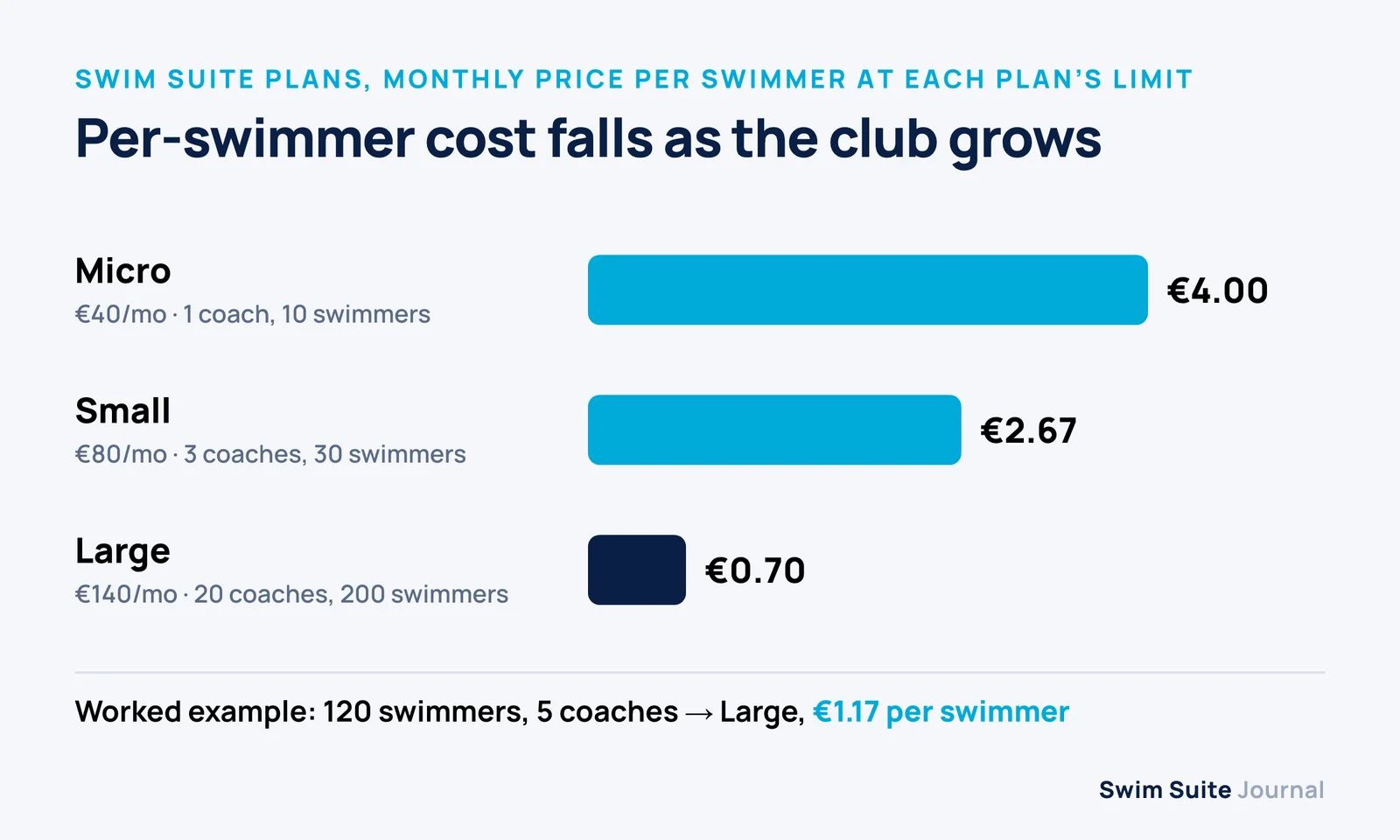
Swim club management software is usually priced per month by club size, counted in swimmers, coaches or both. Compare the price for the size you expect next season, not the size you are today.
As a worked example, these are Swim Suite's published plans:
| Plan | Price per month | Coaches | Swimmers |
|---|---|---|---|
| Micro | €40 | 1 | Up to 10 |
| Small | €80 | Up to 3 | Up to 30 |
| Large | €140 | Up to 20 | Up to 200 |
A club with 120 swimmers in six groups and five coaches needs the Large plan, because Small stops at three coaches and 30 swimmers. That is €140 a month, or about €1.17 per swimmer. Every plan includes both the coach and the swimmer apps, and there is a 14-day free trial with no card required. See all plans on the pricing page.
Where Swim Suite Fits
Swim Suite is swim club management software built for competitive clubs: the coaching column of the table above. It is built around clubs, groups, coaches, swimmers and parents, and covers:
- Season planning from macro cycles down to a single set, with AI-assisted set design
- Groups with responsible coaches, and roles that keep each coach to their own groups
- Attendance and weekly load, compared against the plan
- Competitions in the season plan, with qualifying times per group and per swimmer
- Club chat and shared group documents
- A parent view of schedule, attendance, messages and documents
- Roster import from CSV or Excel
- Swim Forge, the swimmer app, and Swim Analyzer for video analysis, connected to the same club account
What Swim Suite does not do is collect membership fees or sell swim-school lessons. If your club needs those, keep the membership or booking system you have for the money, and use Swim Suite for the sport.
For a closer look at how planning, attendance, statistics and analysis connect, see what swim software covers.
FAQ
The questions clubs most often ask when they start comparing swim club management systems, answered briefly. Each one comes up in almost every first conversation with a club.
What is the difference between swim club and swim team management software?
They describe the same category: software that organises a club's swimmers, groups and coaches. "Team" tends to point at the coaching side, while "club" sometimes also includes membership and fees, so check which one a product actually means.
Can a swimming club database replace spreadsheets?
Yes, once more than one coach or group shares the same information. A database holds each swimmer once, so a change made in one place appears everywhere, which a set of separate spreadsheets cannot guarantee.
How long does it take to switch to a new system?
Most clubs can import their swimmers and set up their groups in an afternoon, then build the first training block the same week. Changing coaches' habits takes longer than moving the data, so start with one group and roll out to the rest once it works.
Is swim club management software only for large clubs?
No. A single coach with ten swimmers gets the same benefit of one plan and one attendance record. The value grows with every extra coach and group that would otherwise keep its own copy of the truth.