
Swim Team Attendance Tracking: What to Record and Why
Swim team attendance tracking is more than ticks: record what each swimmer completed against the plan, and spot dropouts and overload weeks early.
Also in Svenska · Deutsch · Español · Français · Italiano · Nederlands · Norsk · Dansk · Suomi
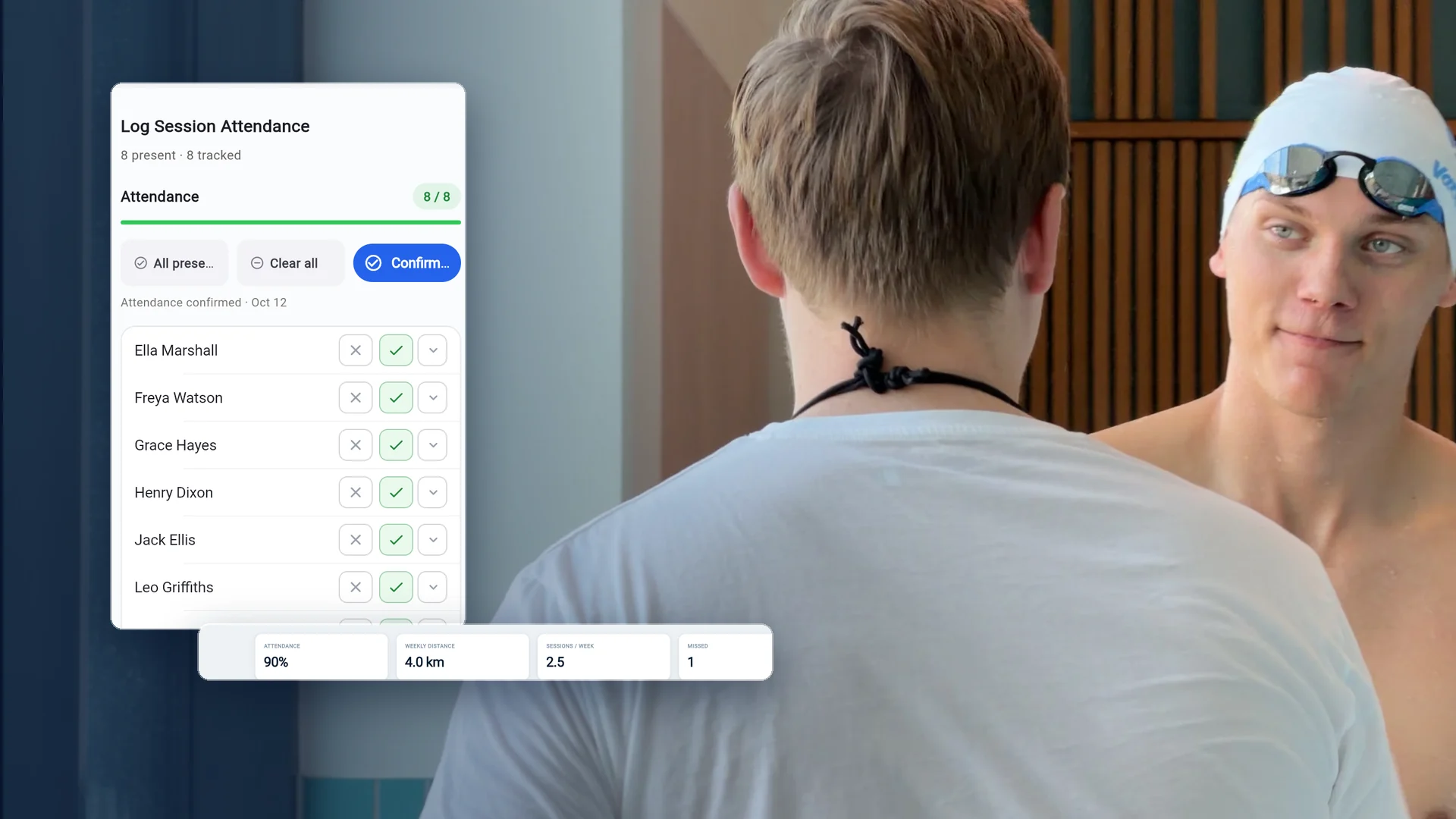
What Is Swim Team Attendance Tracking?
Swim team attendance tracking is the record of which swimmers trained, in which sessions, and how much of the planned work they actually did. Done well, it is the cheapest training data a club has: every coach already takes it, and almost none of them use it.
The register most clubs keep answers only one question — was the swimmer there? The useful questions come after it. Is this swimmer quietly drifting away from the sport? Did the group really swim the volume the season plan assumed? Who is training through an injury they have not mentioned?
What to Record at Every Session
A tick in a box cannot answer any of those questions. Five fields can, and recording them on deck takes under a minute for a lane of eight swimmers once the coach has the habit.
| Field | Example | What it lets you see later |
|---|---|---|
| Status | Present, absent, late, left early | Whether a swimmer's pattern is changing |
| Reason for absence | Ill, injured, school, holiday, no reason | Injuries and drop-out risk, separated from ordinary life |
| Planned distance | 5,200 m | What the plan assumed for the session |
| Completed distance | 4,000 m (out after main set) | The real load each swimmer carried |
| Note | Shoulder sore, kick only for last 800 | Patterns no number shows |
The reason for absence matters more than it looks. Ten missed sessions for school exams and ten missed sessions with no reason are two different swimmers with two different conversations ahead of them.
How to Calculate an Attendance Rate
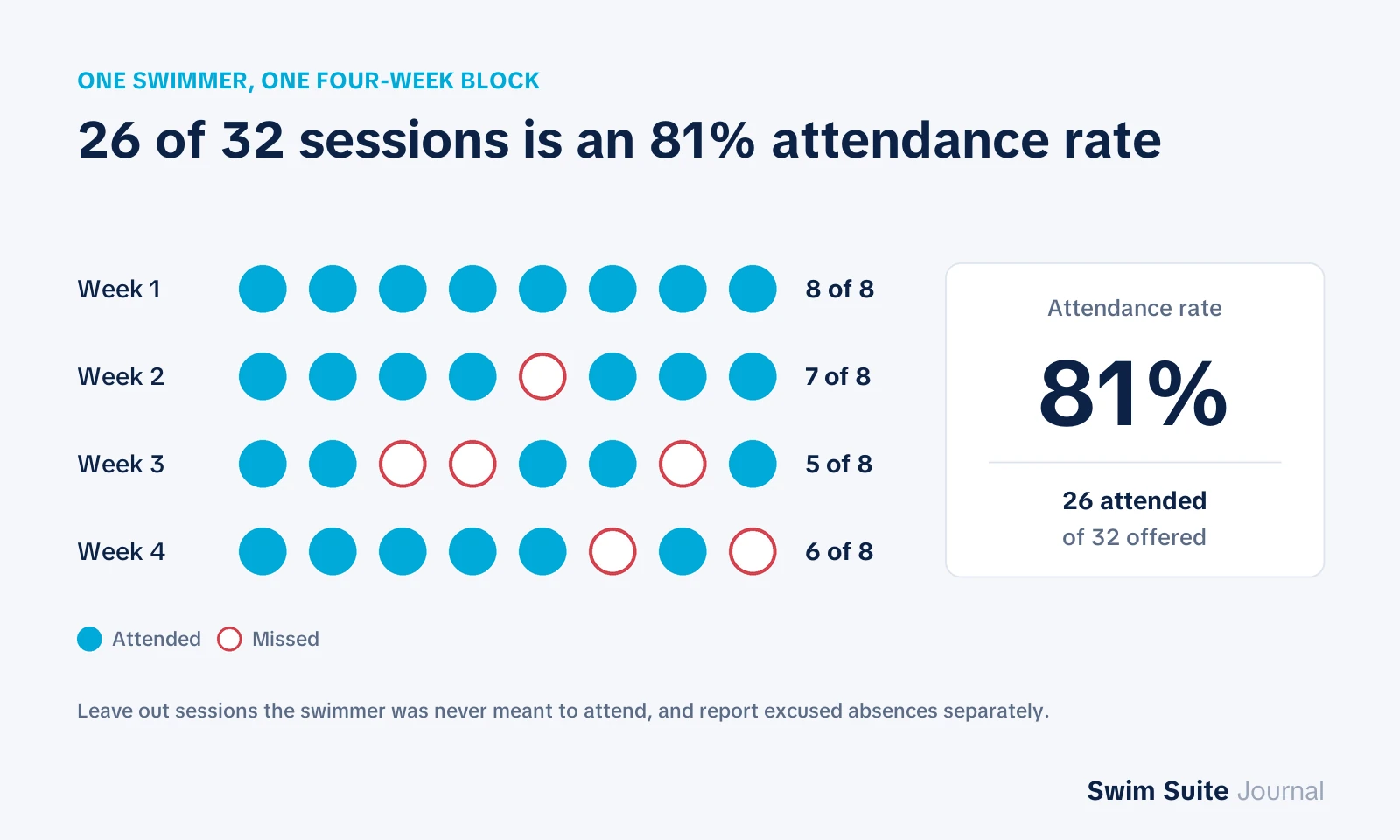
A swimmer's attendance rate is sessions attended divided by sessions offered to their group, over a fixed period. A swimmer who trained 26 of the 32 sessions offered in a four-week block has an attendance rate of 81 percent.
Two refinements make the number fair. Exclude sessions the swimmer was never meant to attend, such as an optional morning they are too young for. And report excused absences separately, so a swimmer who was ill for a week does not look the same as one who stopped turning up.
Worked Example: Planned vs Completed Load
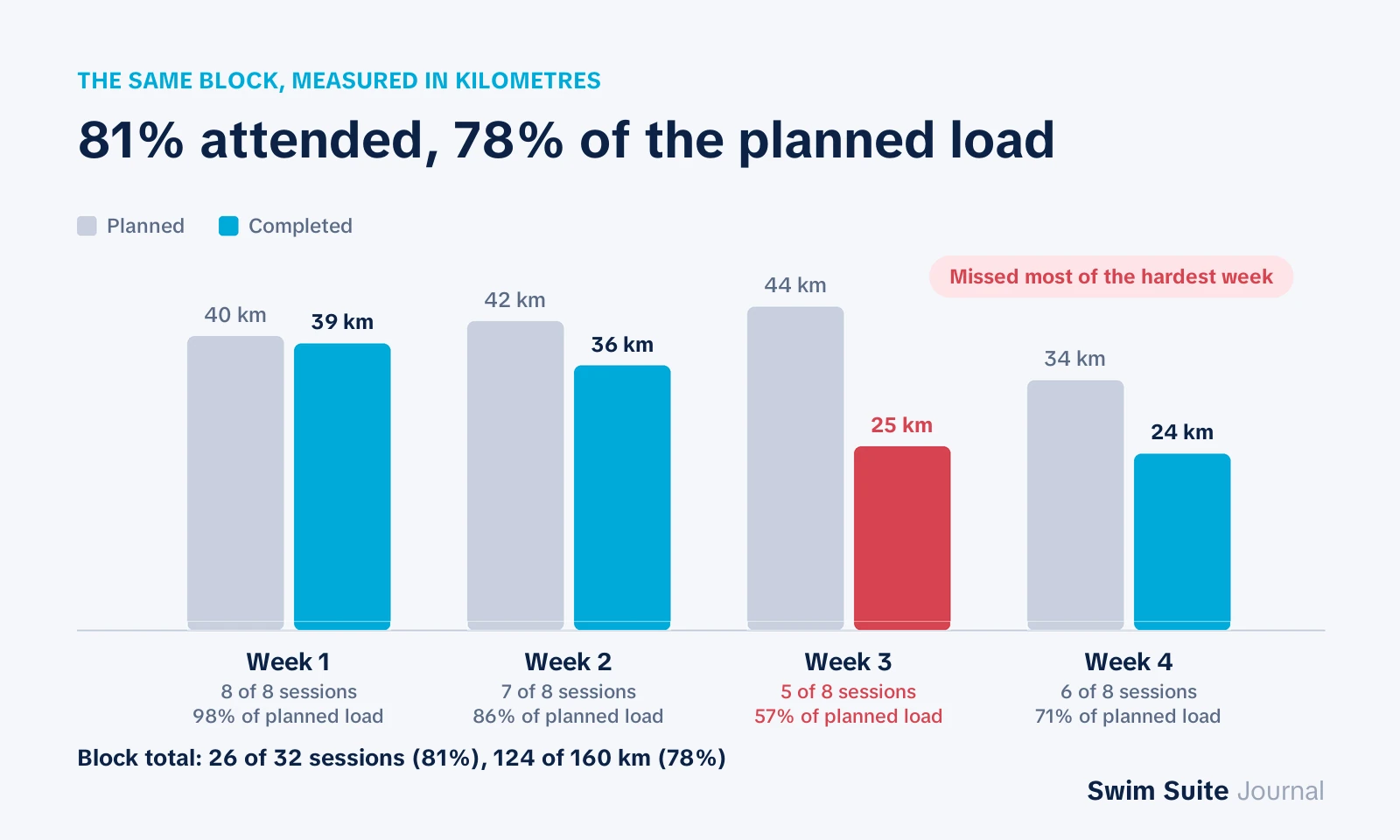
Attendance becomes training data when it is compared with the plan. Here is one swimmer across a four-week block, where the group plan was eight sessions and 40 km a week.
| Week | Sessions attended | Planned volume | Completed volume | Completion |
|---|---|---|---|---|
| 1 | 8 of 8 | 40 km | 39 km | 98% |
| 2 | 7 of 8 | 42 km | 36 km | 86% |
| 3 | 5 of 8 | 44 km | 25 km | 57% |
| 4 | 6 of 8 | 34 km | 24 km | 71% |
| Block | 26 of 32 | 160 km | 124 km | 78% |
The attendance rate for the block is 81 percent, which on its own looks acceptable. The load column tells a different story: the swimmer missed most of the hardest week, so the block's main training stimulus never happened. A coach who sees only the register would test this swimmer in week 4 and wonder why nothing improved.
Early Warning Signs in Attendance Data
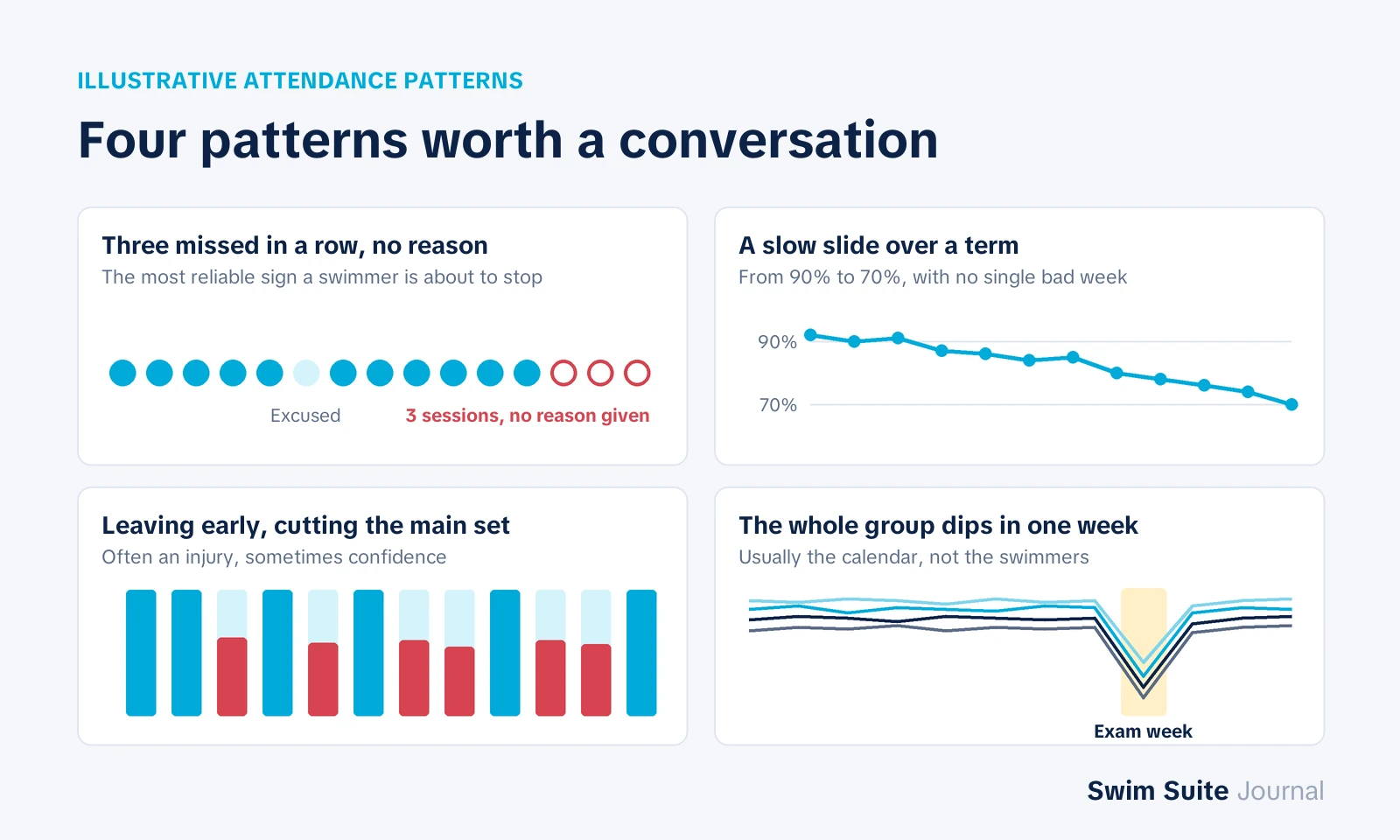
Attendance data shows trouble weeks before a swimmer or parent says anything. These are the patterns worth a conversation, in rough order of urgency.
- Three missed sessions in a row with no reason given. The most reliable early sign that a swimmer is about to stop.
- A steady slide over a term, for example from 90 percent to 70 percent, even if no single week looks bad.
- Repeatedly leaving early or cutting the main set. Often an injury, sometimes a confidence problem.
- Perfect attendance alongside falling performance. Not every warning is an absence; a swimmer who never misses and keeps getting slower may be overloaded.
- A whole group dipping in the same week. Usually the calendar — exams, holidays — and a reason to move the hard block, not to chase swimmers.
Taking Attendance on Deck Without Losing Time
Attendance gets skipped when it costs the coach time at the start of the session. Three habits keep it fast.
First, take it in the water, not at the poolside door: by the end of the warm-up the coach knows who is there. Second, record exceptions only, so the default is "present, completed the plan" and the coach marks the absentees and the swimmers who did something different. Third, do it in the same place the session plan lives, so planned distance is already filled in and only the differences need entering.
Attendance Data and Privacy
Attendance records for minors are personal data, and in the EU and UK they fall under GDPR. Keep them to the purpose the club collects them for — running training and looking after swimmers — and limit who can see them.
In practice that means a group coach sees their own groups, the head coach sees all of them, and parents see their own child's attendance but nobody else's. Injury notes deserve particular care, because health information is a special category of data. Record what the coach needs to adjust training, not a medical history.
Where Attendance Lives in a Club System
A paper register or a shared spreadsheet can hold the status column. It cannot easily hold planned against completed load per swimmer, because the plan lives somewhere else. Holding the plan and the attendance together is what separates coaching software from team administration software, as the guide to the five types of swim software explains.
In Swim Suite, attendance is recorded against the sessions in the season plan, so planned and completed weekly load sit side by side for each swimmer, and parents see their own child's schedule and attendance in the parent view. The swim team management software page shows how the plan and the attendance record connect. For what else to look for when choosing a system, see how to choose swim club management software.
Attendance is part of every Swim Suite plan, not an add-on, and the 14-day free trial needs no card, which is long enough to take attendance for one group through two full training weeks and compare it with the plan. The plans and prices page shows what each club size costs.
FAQ
Short answers to the questions coaches and club administrators ask most when they start tracking attendance properly rather than keeping a register for its own sake.
What is a good attendance rate for a competitive swim group?
Most competitive club groups expect 80 to 90 percent of offered sessions, with higher expectations for national-level squads. The expectation matters less than consistency: a swimmer steady at 80 percent usually progresses better than one swinging between 100 and 50.
Should swimmers make up missed sessions?
Usually not by adding extra sessions. A missed hard session is better replaced by adjusting the next week, because squeezing two sessions' load into one week is how overuse injuries start.
Who should take attendance in a club with several coaches?
The coach running the session, every time. Attendance taken later from memory, or by an administrator from a sign-in sheet, loses exactly the details — left early, cut the main set, sore shoulder — that make it useful.