
Swim Season Planning: A Template for Club Coaches
Plan a swim season backwards from the target meet: phases, training blocks and weekly load, with a worked 40-week template for a club group.
Also in Svenska · Deutsch · Español · Français · Italiano · Nederlands · Norsk · Dansk · Suomi
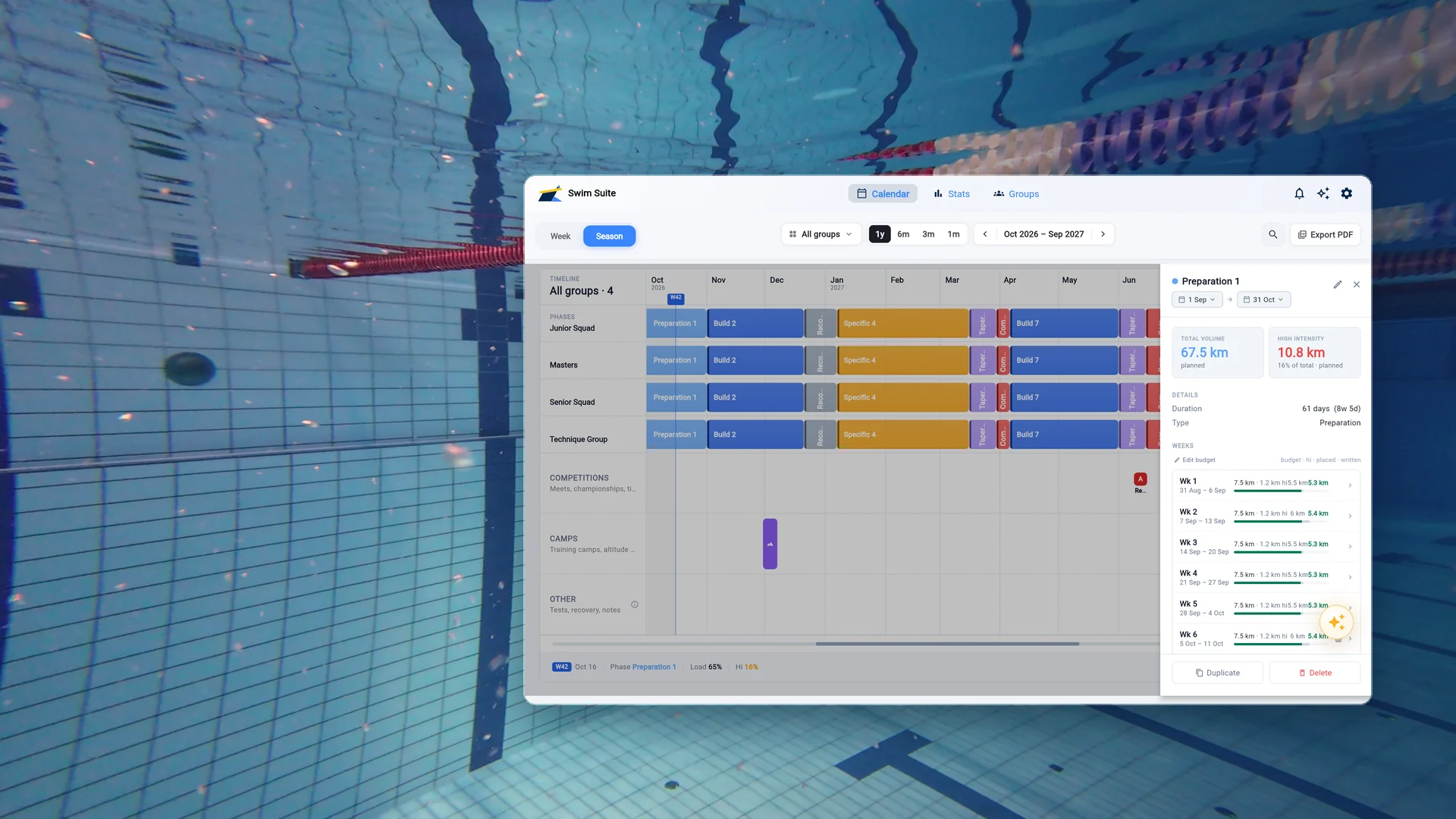
What Is a Swim Season Plan?
A swim season plan is the coach's map from the first session of the season to the meet the group is aiming at, broken into phases, training blocks and weeks. It decides what each part of the season is for before anyone writes a single set.
Without one, training drifts towards whatever the coach felt like on the day. With one, every session has a reason to exist, and when a week goes wrong — illness, a pool closure, a school exam period — the coach can see what was lost and where to make it up.
The Three Levels of a Season Plan
Every periodised plan, however it is drawn, has the same three levels. Naming them keeps the conversation between coaches precise.
| Level | Usual name | Typical length | What it decides |
|---|---|---|---|
| Season | Macrocycle | 16–52 weeks | The target meet, the phases and their order |
| Block | Mesocycle | 3–6 weeks | One training emphasis and its load progression |
| Week | Microcycle | 7 days | Session order, hard and easy days, total volume |
Below the week sits the session, and below the session the set. Those belong to the plan too, but they change often. The season and its blocks should change rarely, and only for a reason the coach can name.
How to Build a Season Plan Backwards
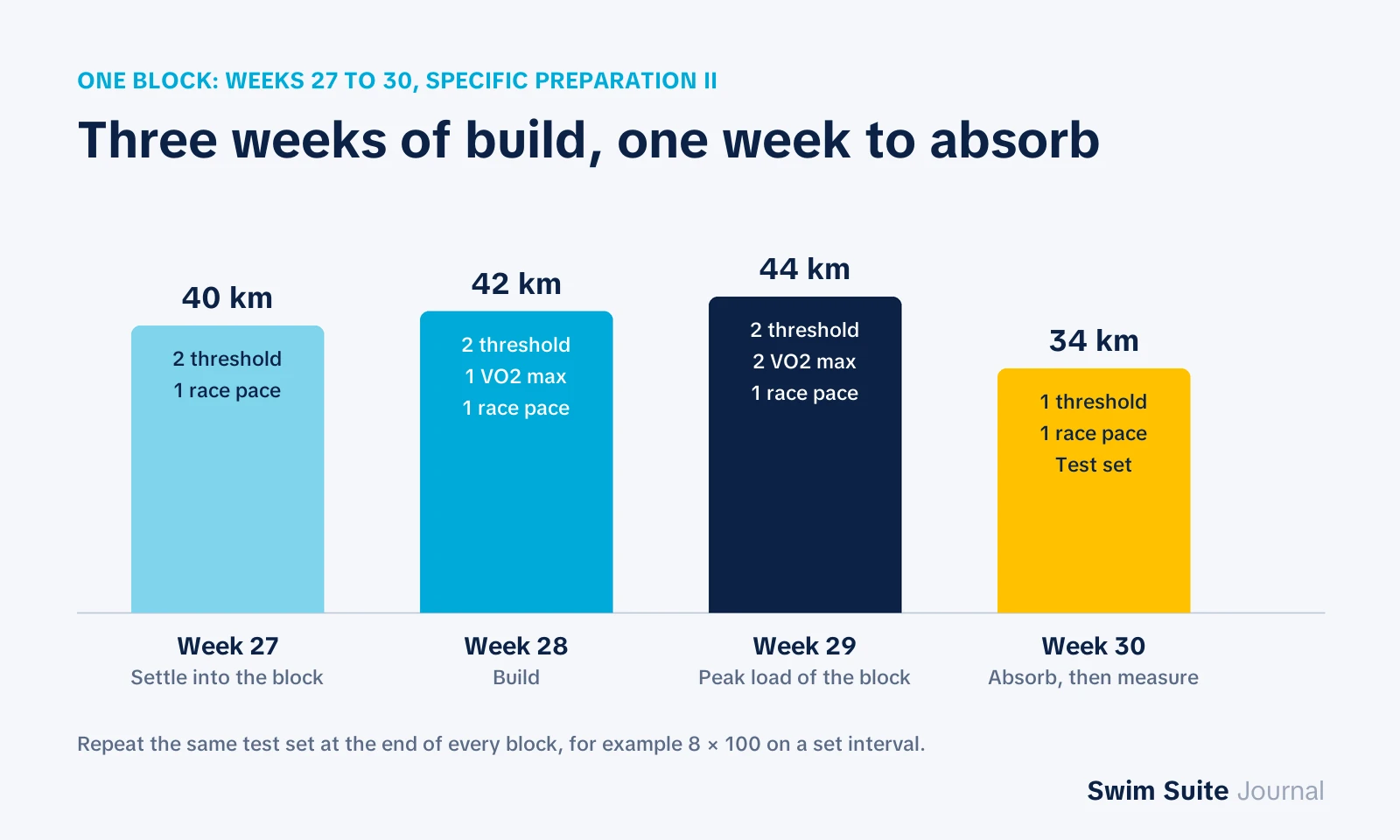
Start from the date of the meet that matters most and work back to today. Planning forwards from September produces a season that peaks whenever the weeks happen to run out.
- Fix the target meet. One per peak. A group can have two peaks a season, rarely three.
- Place the taper. One to three weeks before the target meet, depending on the swimmers' age and training load.
- Place the competition phase. Four to eight weeks before the taper, where race-pace work and racing take over.
- Fill the remaining weeks with preparation. General preparation first (aerobic base, technique, strength), then specific preparation (the energy systems the group's main events need).
- Put the fixed dates in. School holidays, pool closures, training camps and the smaller meets. They decide where recovery weeks fall more often than physiology does.
- Only then write the blocks. Each block gets one emphasis and a load target, and every fourth week or so is lighter.
A Worked 40-Week Template
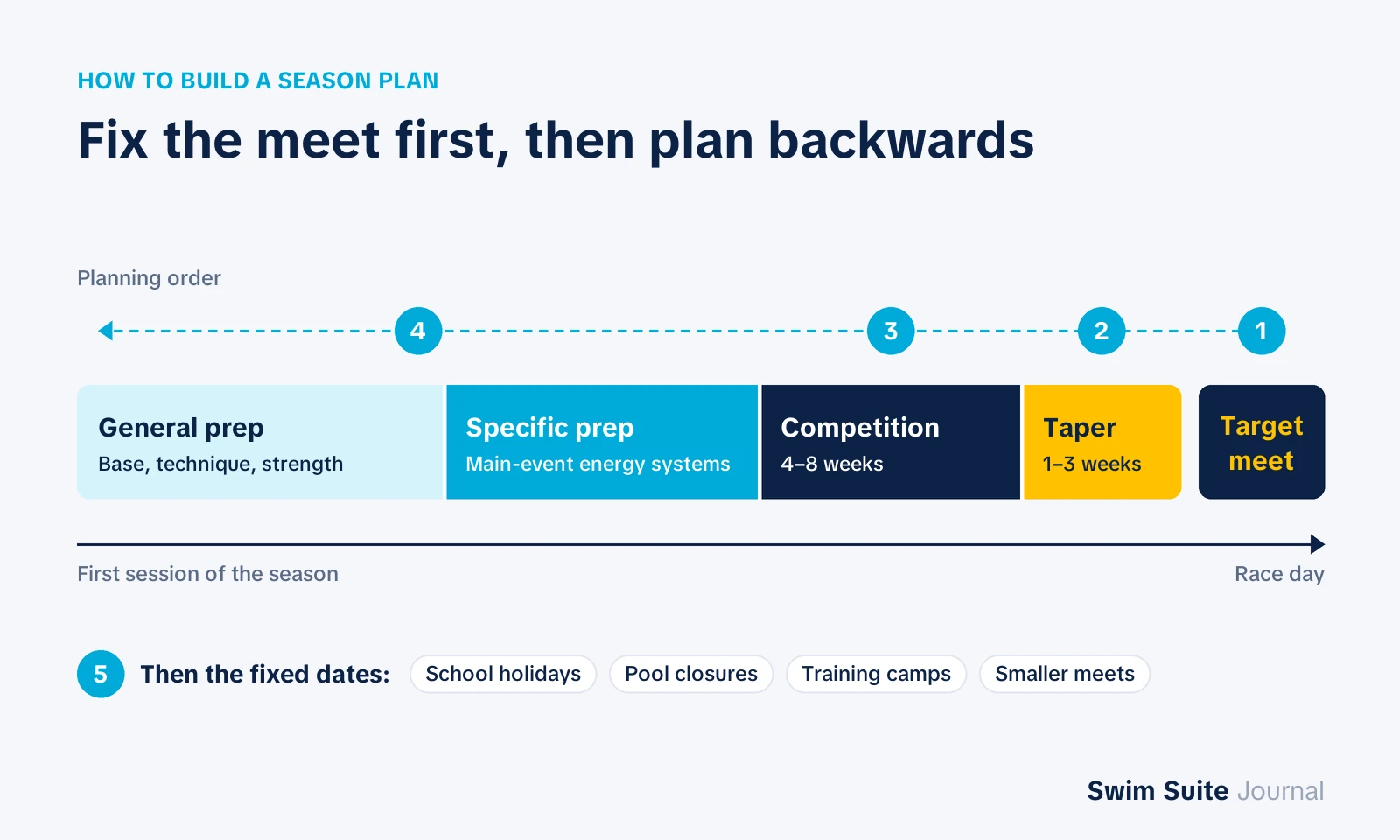
Here is a complete season for a performance group of 14 to 16-year-olds training eight pool sessions a week. It has two peaks: short-course championships in week 16 and long-course championships in week 40. The volumes are an example for this kind of group, not a prescription for yours.
| Weeks | Phase | Emphasis | Weekly volume |
|---|---|---|---|
| 1–2 | Transition in | Technique, re-adaptation | 20–25 km |
| 3–8 | General preparation | Aerobic base, drills, kicking, dryland strength | 32–40 km |
| 9–12 | Specific preparation | Threshold, main-event pace, starts and turns | 38–42 km |
| 13–14 | Competition | Race pace, a club meet as rehearsal | 34–36 km |
| 15–16 | Taper and SC champs | Speed, rest, racing | 18–24 km |
| 17–18 | Recovery | Easy aerobic, technique, holiday break | 15–20 km |
| 19–26 | General preparation II | Aerobic capacity, higher volume | 38–45 km |
| 27–32 | Specific preparation II | Threshold, VO₂ max sets, race pace | 40–44 km |
| 33–37 | Competition II | Race pace, two qualifying meets | 34–38 km |
| 38–40 | Taper and LC champs | Speed, rest, racing | 18–26 km |
Two things in the template are deliberate. The second preparation phase is longer and heavier than the first, because the long-course meet is the season's main target. And the short-course taper is only two weeks: a group that is still building towards July does not need, and cannot afford, a full rest before December.
What One Block Looks Like
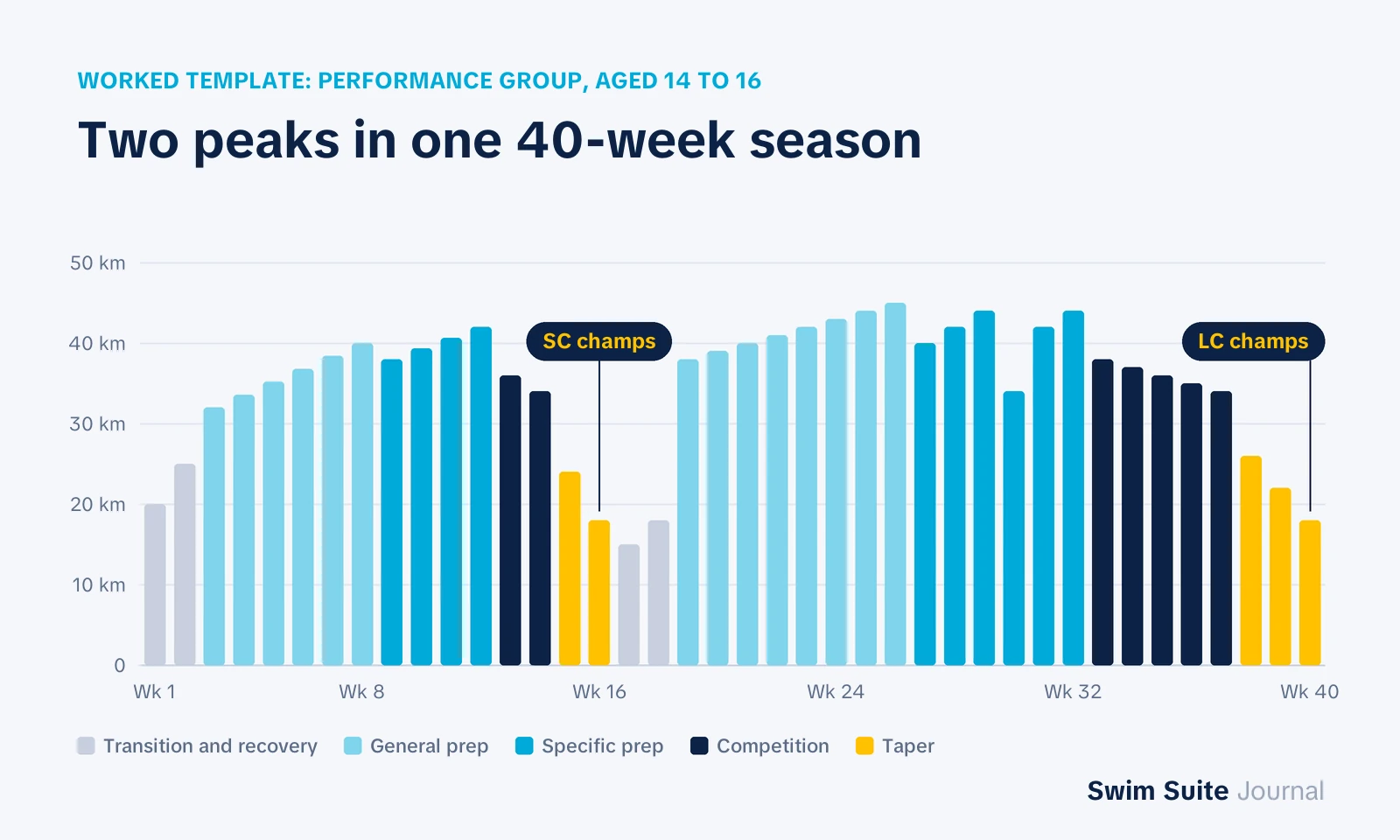
Zoom into weeks 27 to 30, the first block of specific preparation II. The load builds for three weeks and drops in the fourth, so the swimmers absorb the work instead of carrying fatigue into the next block.
| Week | Volume | Key sets | Purpose |
|---|---|---|---|
| 27 | 40 km | 2 threshold, 1 race pace | Settle into the block |
| 28 | 42 km | 2 threshold, 1 VO₂ max, 1 race pace | Build |
| 29 | 44 km | 2 threshold, 2 VO₂ max, 1 race pace | Peak load of the block |
| 30 | 34 km | 1 threshold, 1 race pace, test set | Absorb, then measure |
The test set in week 30 is what makes the block honest. Repeat the same test at the end of every block — a fixed 8 × 100 on a set interval, for example — and the season plan starts producing evidence instead of hope. Count stroke cycles on one length of each repeat as well, and the test also shows whether a faster time came from a longer stroke or a higher stroke rate.
How Long Should a Swim Taper Be?
A swim taper usually lasts one to three weeks, with volume cut by roughly 40 to 60 percent while intensity is kept. Younger swimmers and groups on lower weekly volume need the short end; older swimmers coming off heavy training need the long end.
The mistake to avoid is cutting intensity along with volume. Swimmers who only swim easy in the last fortnight tend to arrive rested but flat. Keep short race-pace efforts in every taper week, and cut the distance around them.
Common Season Planning Mistakes
Most failed season plans fail in the same handful of ways, and none of them is about the physiology.
- Planning forwards. The season ends where the weeks run out rather than where the meet is.
- Too many peaks. Every meet treated as important means none of them gets a real taper.
- No recovery weeks. Load that only ever goes up stops being training and starts being attrition.
- Ignoring the calendar. An exam fortnight or a pool closure in the middle of the hardest block wrecks it. Put them in first.
- A plan nobody compares with reality. If the planned volume and the volume swimmers actually completed are never set side by side, the plan is a wish list.
Keeping the Plan and the Training Connected
A season plan in a spreadsheet works until the first week goes off plan. Then the sessions get written somewhere else, attendance lives on a third sheet, and by February nobody can say what the group actually trained.
That gap is what season planning software closes. In Swim Suite the macrocycle, the blocks and the weeks live in one plan, the sessions are built inside it, and attendance is recorded against the same sessions, so planned and completed load sit next to each other for each swimmer. If you are still choosing a system for the whole club, start with how to choose swim club management software.
Every Swim Suite plan includes the season planner, and the 14-day free trial needs no card, which is long enough to put the target meets in, place the tapers and build the first block. The plans and prices page shows what each club size costs.
FAQ
The questions coaches ask most often when they sit down to plan a season for the first time, usually in August with a blank calendar and a championship date already fixed by the federation.
How far ahead should a swim coach plan?
A swim coach should plan the whole season at phase level, the next block in detail, and the next week in full. Planning every session for the season in advance wastes the work, because the swimmers' response to the first blocks should change the later ones.
How many training blocks should a season have?
Most club seasons have eight to twelve blocks of three to six weeks each. Fewer, longer blocks suit younger swimmers who are mainly building an aerobic base; shorter blocks suit older swimmers working on several specific qualities.
Should age-group swimmers follow a periodised plan?
Yes, but with fewer phases and less variation in load. For swimmers under twelve the plan is mostly technique and aerobic development with a light taper for the main meets, and the main benefit is that the coach knows what each term is for.