
What Is SWOLF in Swimming? Score, Formula and Limits
SWOLF adds your time for one length to your stroke count. How to calculate it, what a good score is, and why it can reward a slower swim.
Also in Svenska · Deutsch · Español · Français · Italiano · Nederlands · Norsk · Dansk · Suomi · Magyar
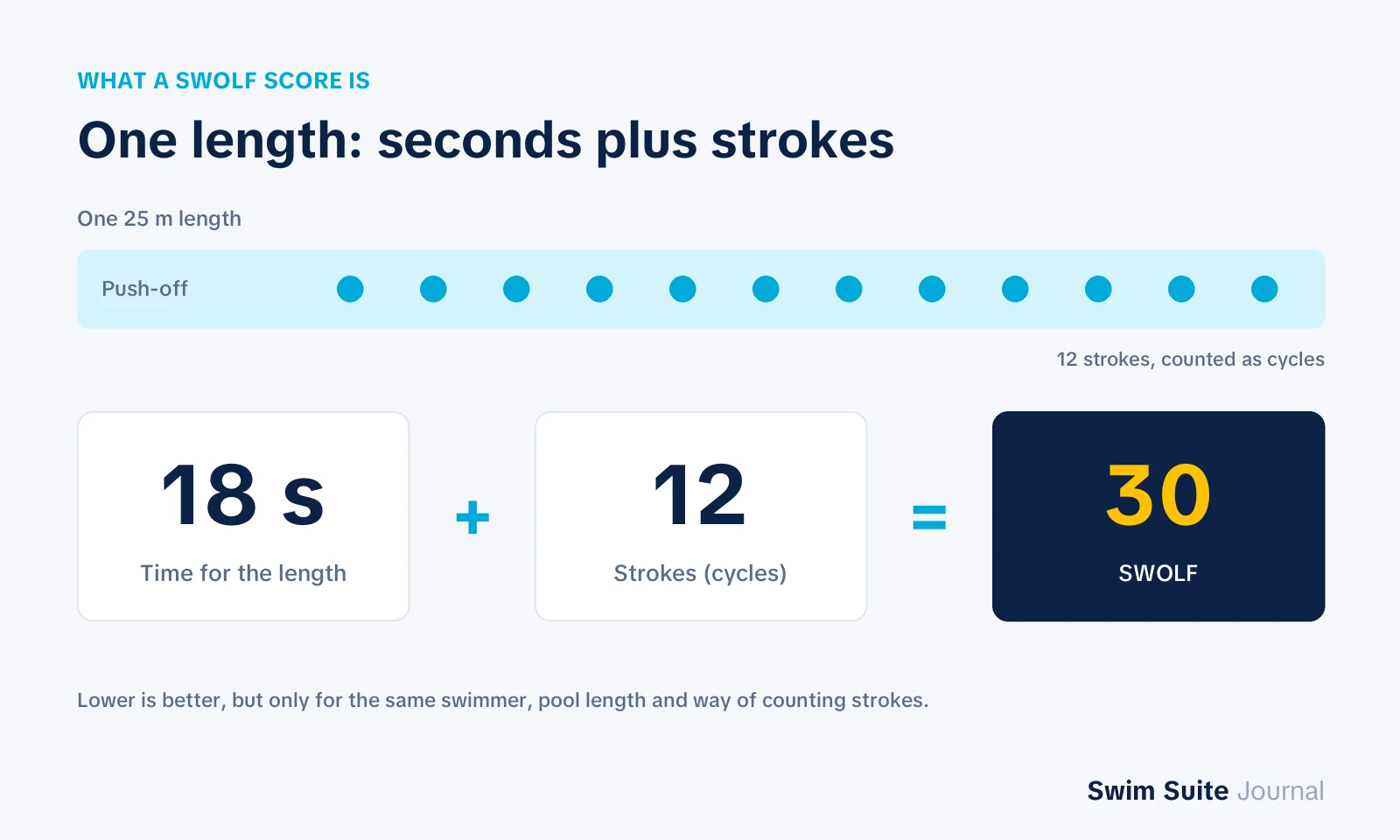
SWOLF is a swimming efficiency score: the time in seconds it takes to swim one length, plus the number of strokes taken on that length. A swimmer who covers 25 metres in 18 seconds with 12 strokes has a SWOLF of 30. Lower is better, and most swim watches show it after every length. The number is useful once you know what it rewards, which is slightly different from swimming fast.
How do you calculate SWOLF?
You calculate SWOLF by adding the seconds for one length to the strokes taken on that length. The name blends swim and golf because, as in golf, the lower the score the better.
SWOLF = time for one length (s) + strokes on that length
Two details decide whether your number can be compared with anyone else's:
- What counts as a stroke. Garmin watches count one stroke each time the arm wearing the watch completes a cycle, so a freestyle length of 24 hand entries reads as 12 strokes. A coach counting hand entries on deck gets 24, and a SWOLF 12 points higher for the same swim. Count cycles, as the guide to calculating stroke length explains, and note the convention next to the number.
- Pool length. A SWOLF from a 50 m pool covers twice the distance and reads roughly double the 25 m figure. Halve it to compare, and still expect a difference, because a 50 m pool has half as many push-offs.
What is a good SWOLF score?
A good SWOLF is one lower than your own last score at the same pace. Between swimmers the number says little, because a tall swimmer takes fewer strokes and a strong push-off shortens the swimming on every length. As rough orientation for freestyle in a 25 m pool, counting strokes as cycles:
| Swimmer | Typical 25 m time | Strokes (cycles) | SWOLF |
|---|---|---|---|
| Beginner | 35–45 s | 18–24 | 55–70 |
| Fitness swimmer | 26–34 s | 14–18 | 40–52 |
| Trained club swimmer, aerobic pace | 20–23 s | 10–13 | 30–36 |
| National-level swimmer, aerobic pace | 16–18 s | 8–10 | 24–28 |
Treat the ranges as a sense of scale. They follow from typical paces and stroke counts rather than a published dataset, and an individual can sit outside them for good reasons.
SWOLF counts one second as one stroke
SWOLF adds seconds and strokes as if they were worth the same, and that exchange rate is arbitrary. Take one more stroke and you have to be a full second faster to keep the same score, and over 25 metres a second is a lot of speed.
Here are two lengths with the same SWOLF of 32:
- Length A: 20 seconds and 12 strokes.
- Length B: 17 seconds and 15 strokes.
Length B takes 15 percent less time. Held over 100 metres it is 1:08 pace against 1:20, and the score cannot tell the two apart.
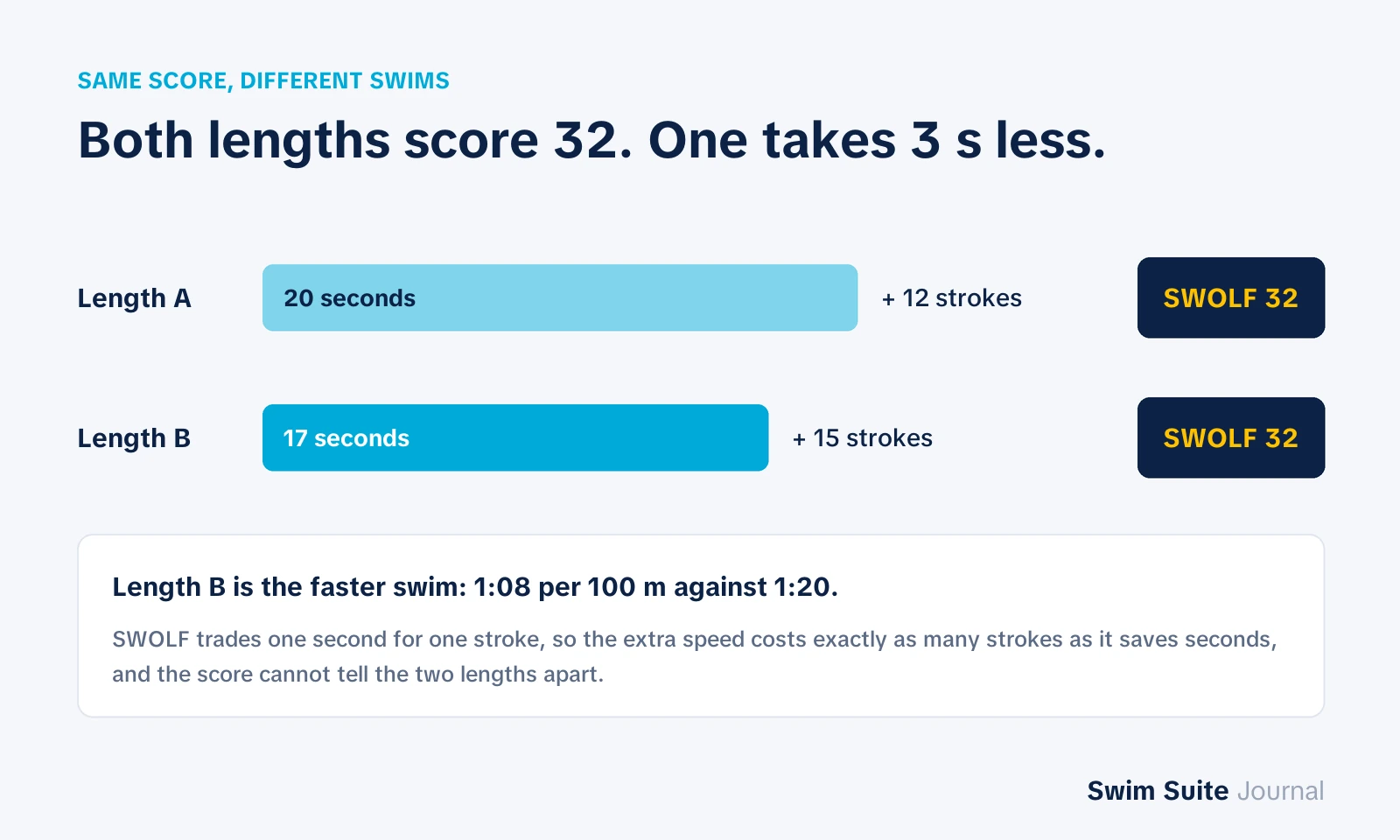
The trap follows directly. A swimmer chasing a lower SWOLF can get there by gliding: fewer strokes, a slightly slower length, and the same or a better score. It is the same failure as coaching stroke count as a target in its own right. The fix is to compare SWOLF only at a fixed speed.
Why the lowest SWOLF is not your fastest swim
Plot one swimmer's SWOLF across a range of speeds and it forms a shallow U. At easy pace the seconds dominate the score; at all-out pace the extra strokes do. The bottom of the U is usually a comfortable aerobic speed, well short of race pace.
| Time per 25 m | Strokes (cycles) | SWOLF |
|---|---|---|
| 22.0 s | 11 | 33.0 |
| 20.0 s | 11.5 | 31.5 |
| 18.5 s | 12.5 | 31.0 |
| 17.5 s | 14 | 31.5 |
| 16.8 s | 16 | 32.8 |
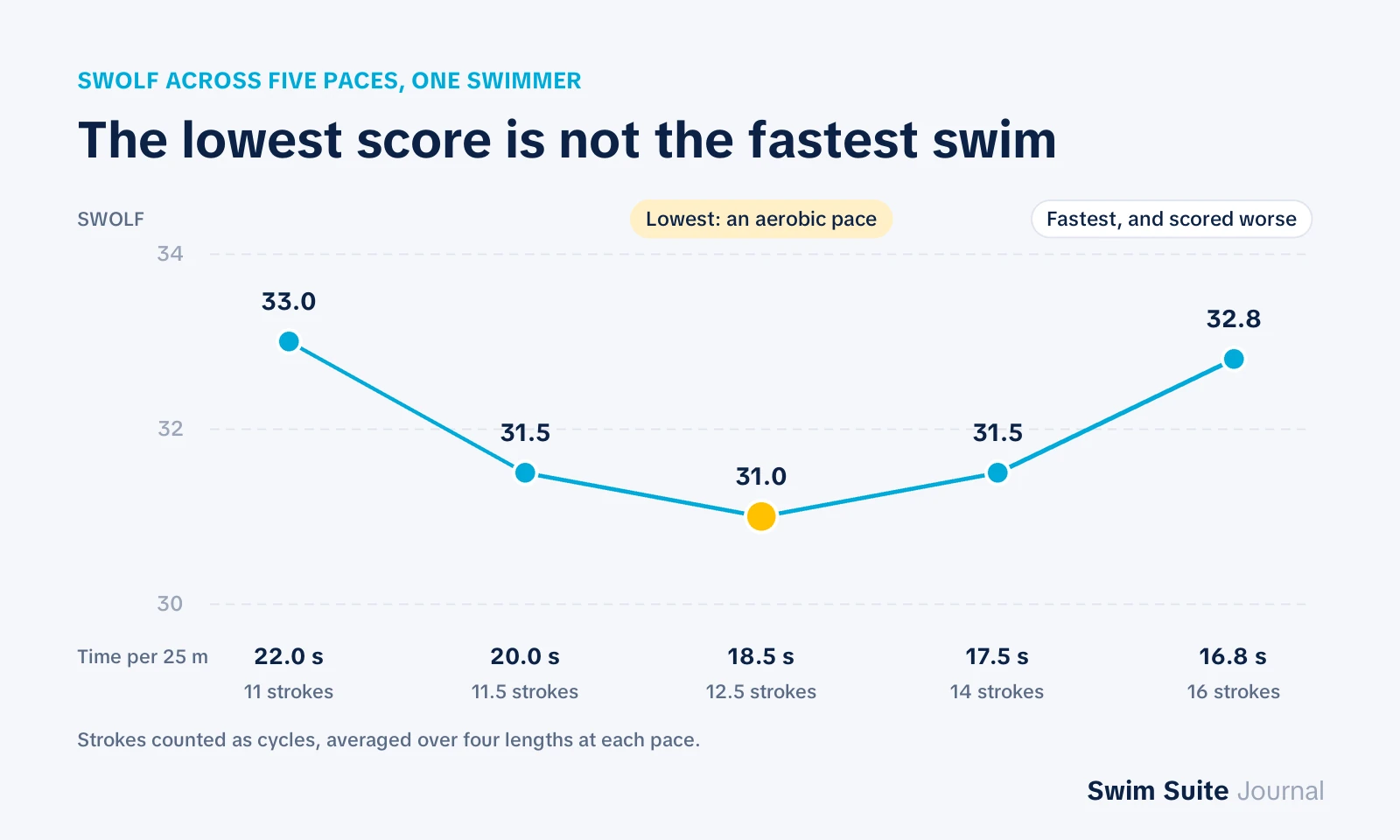
That shape is why SWOLF works as a technique number at one fixed pace, not as a performance number. The swimmer above should not race a 50 at 18.5 seconds per length because that is where their SWOLF is lowest.
How to use SWOLF properly
Use SWOLF the way you would use heart rate at a set pace: hold the speed constant and watch the score.
- Pick a test set and repeat it. For example 8 × 50 freestyle on a send-off that leaves about 15 seconds of rest, holding the same time on every repeat. Record the SWOLF of the second length of each 50, after a push-off rather than a dive.
- Hold the pace, not the score. If the time drifts, the SWOLF is not comparable with last month's. Swim to the pace clock and let the strokes be whatever they are.
- Compare against yourself, in the same pool. Same pool length, same stroke counting, same set every four to six weeks.
- Read the two parts separately. A lower SWOLF made of fewer strokes at the same time is a longer stroke. One made of a faster time at the same strokes is more speed. They are different improvements and call for different sets.
For a coach with a whole group, the test belongs in the season plan, so it comes round on schedule rather than when someone remembers. In a season plan in Swim Suite a test set is a session like any other, and its results sit next to the training that produced them.
SWOLF versus stroke length and stroke rate
SWOLF folds two measurements into one number, and they are the two a coach actually needs. Speed over a length is stroke length times stroke rate. A SWOLF of 30 could be a long, slow stroke or a short, quick one, and those call for opposite corrections.
Stroke length and stroke rate keep them apart. Taken over the clean swimming section, without the push-off, they tell you which half of the speed changed. The stroke length calculator works out both from a distance, a time and a stroke count. Swim Analyzer measures them from phone video, with the push-off and breakout detected rather than estimated, which a watch on the wrist cannot see. Swim Analyzer Pro is included in every Swim Suite plan; see plans and pricing.
SWOLF still earns its place as a quick, free, repeatable check on your own swimming, recorded by your watch on every length. Just do not let it set the pace.
Is a lower SWOLF always better?
Only at the same speed. A lower SWOLF from fewer strokes at the same time is an improvement; a lower SWOLF from gliding at a slower pace is not.
Does SWOLF include the push-off?
Yes. A watch times the whole length from wall to wall, so a longer push-off and underwater lowers SWOLF without any change to the stroke. Compare only lengths swum with the same push-off.
How do you compare SWOLF in a 25 m and a 50 m pool?
Halve the 50 m figure for a rough comparison, then expect it to read slightly worse than the 25 m score, because a 50 m pool has half as many push-offs per 100 metres.