
How to Read a Pace Clock and Set Send-Off Intervals
How swimmers read a pace clock, what leaving on the top means, and how coaches set send-off intervals and rest for each kind of set.
Also in Svenska · Deutsch · Español · Français · Italiano · Nederlands · Norsk · Dansk · Suomi · Magyar
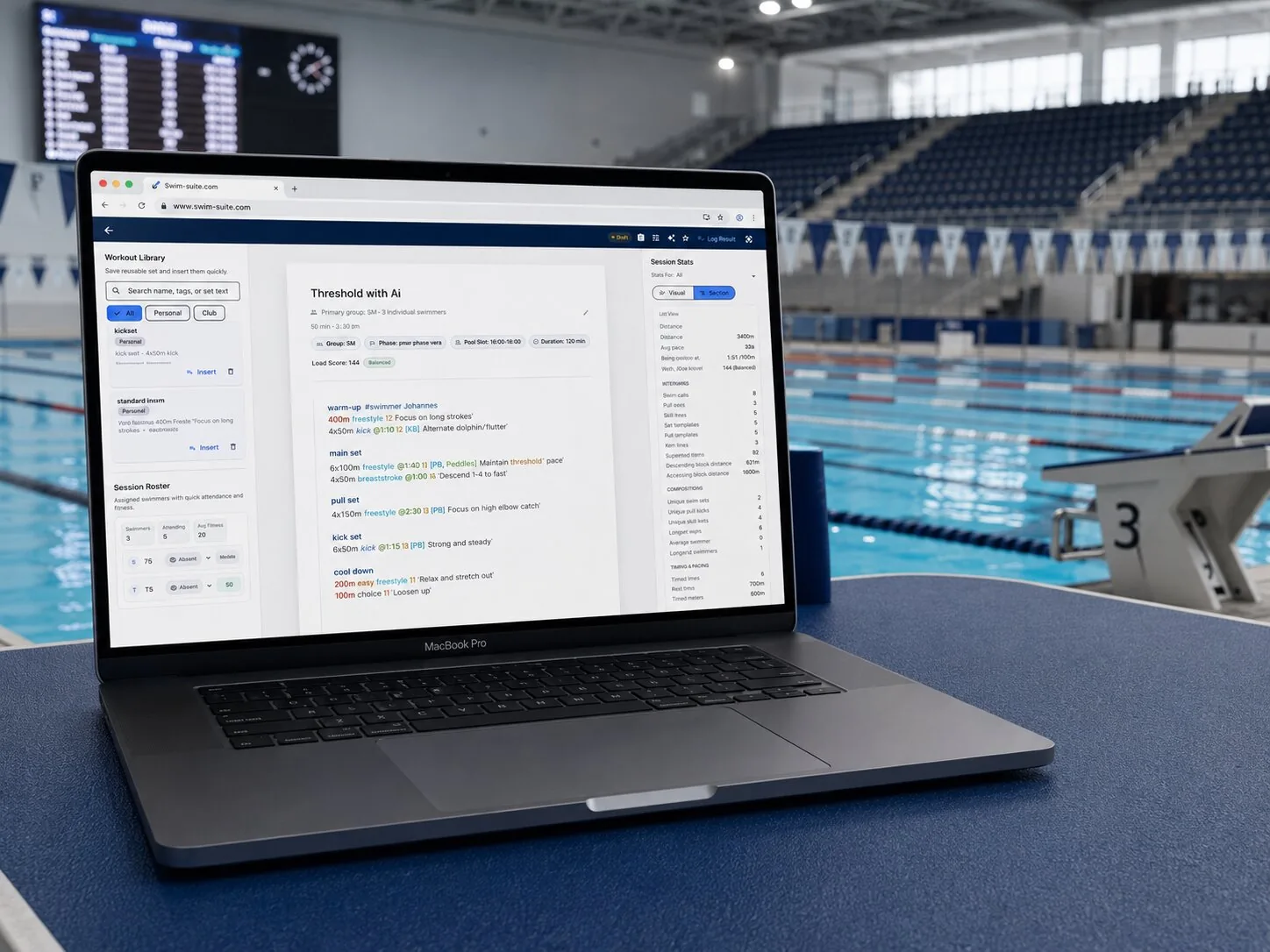
A pace clock is the large clock on a pool wall, with a single hand or a digital readout, that goes round once a minute. Swimmers leave on an agreed position, usually "the top" when the hand points at 60, and read their time when they touch the wall. In a set like 6 × 100 on 1:20, a new 100 starts every 1 minute 20 seconds, and whatever is left after the swim is the rest. Reading the clock is one of the first things a club swimmer learns; setting good intervals is one of the quieter skills of coaching.
How do you read a pace clock?
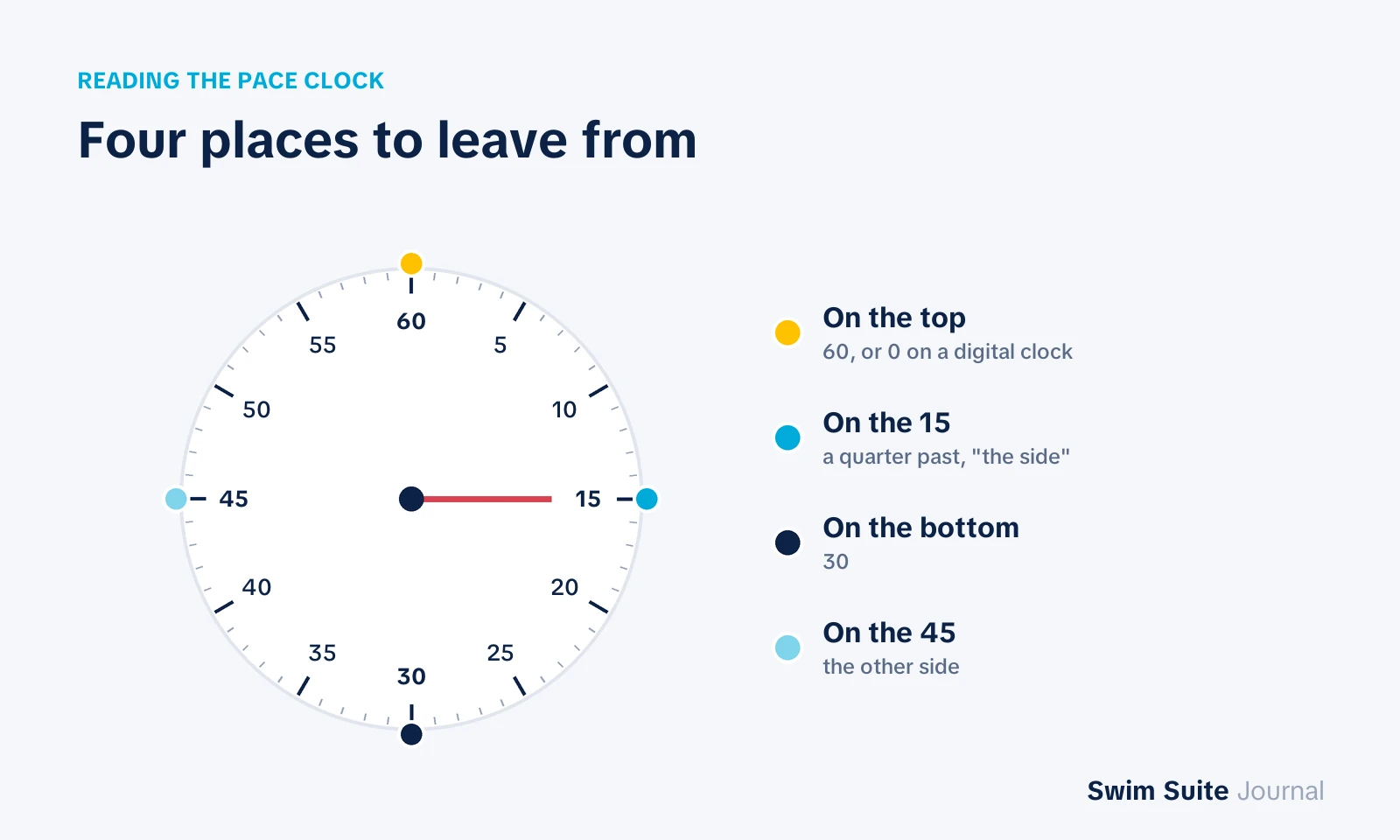
You read a pace clock by noting where the hand is when you leave and where it is when you touch, then counting the time between. Leave on the top and the arithmetic disappears: the hand shows your seconds directly, and you add a minute for every time it passes the top.
The four starting positions have names on every pool deck:
- The top: 60, or 0 on a digital clock.
- The 15: a quarter past, sometimes called the side.
- The bottom: 30.
- The 45: three quarters round, the other side.
Leaving on any other position works the same way with one extra step. A swimmer who leaves on the bottom and touches when the hand points at 50, with the hand passing the top once on the way, has swum 30 seconds to the top plus 50 after it: 1:20. Counting how often the hand passes the top is what beginners lose track of on longer swims, which is why most pools have at least one digital clock that shows minutes as well.
What does "6 × 100 on 1:20" mean?
It means six 100 m swims, with a new one starting every 1 minute 20 seconds, and the time between finishing one and starting the next is the rest. The 1:20 is the send-off interval, and it is fixed: swim the 100 in 1:12 and you rest 8 seconds, swim it in 1:16 and you rest 4.
| Repeat | Leaves at | Clock hand | Swim | Rest |
|---|---|---|---|---|
| 1 | 0:00 | Top | 1:12 | 8 s |
| 2 | 1:20 | 20 | 1:12 | 8 s |
| 3 | 2:40 | 40 | 1:13 | 7 s |
| 4 | 4:00 | Top | 1:13 | 7 s |
| 5 | 5:20 | 20 | 1:14 | 6 s |
| 6 | 6:40 | 40 | 1:13 | 7 s |
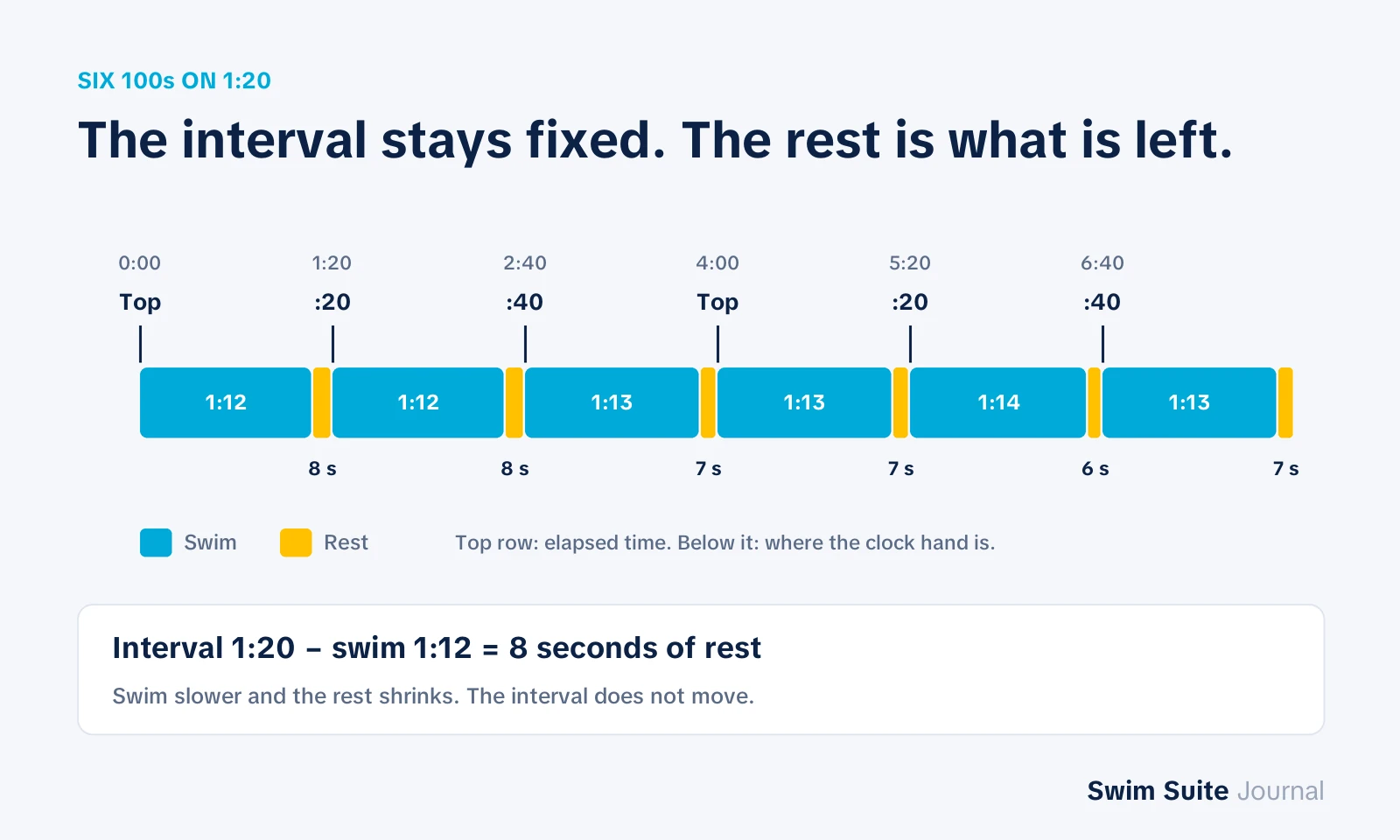
A 1:20 interval brings the departure back to the top every three repeats, which makes it easy to follow. So do 1:15, 1:30, 1:40 and 1:45. An interval like 1:25 only returns to the top after twelve repeats, so swimmers spend the set doing sums instead of swimming.
When several swimmers share a lane they leave five or ten seconds apart, the first on the top, the next on the 5 and so on, so each has clear water and their own departure time to read.
How to set a send-off interval
Start from the pace you want the swimmer to hold, then add the rest the set needs:
Send-off interval = target swim time + rest
The target swim time should come from the swimmer, not the lane. For threshold work it comes from a test such as critical swim speed: a swimmer with a CSS of 1:30 per 100 m swims threshold 100s at about 1:30, and with 15 seconds of rest that is a send-off of 1:45. Round to an interval the clock makes easy to follow: 1:45 lands on the top, the 45, the bottom and the 15 in turn.
How much rest each kind of set needs
The rest is not padding. It decides which energy system the set trains, so it deserves the same thought as the distance and the pace.
| Set type | Typical rest | Work : rest | Example |
|---|---|---|---|
| Aerobic endurance | 10–20 s | about 6:1 to 10:1 | 5 × 200 with 15 s rest |
| Threshold | 10–20 s | about 5:1 to 8:1 | 10 × 100 on 1:45 for a 1:30 swimmer |
| VO2 max | 30–60 s | about 2:1 to 1:1 | 8 × 100 on 2:15 for a 1:25 swimmer |
| Race pace | 2–3 times the swim | 1:2 to 1:3 | 6 × 50 on 1:30 for a 30 s swimmer |
| Sprint | 1–3 minutes | 1:5 or more | 8 × 25 all out on 2:00 |
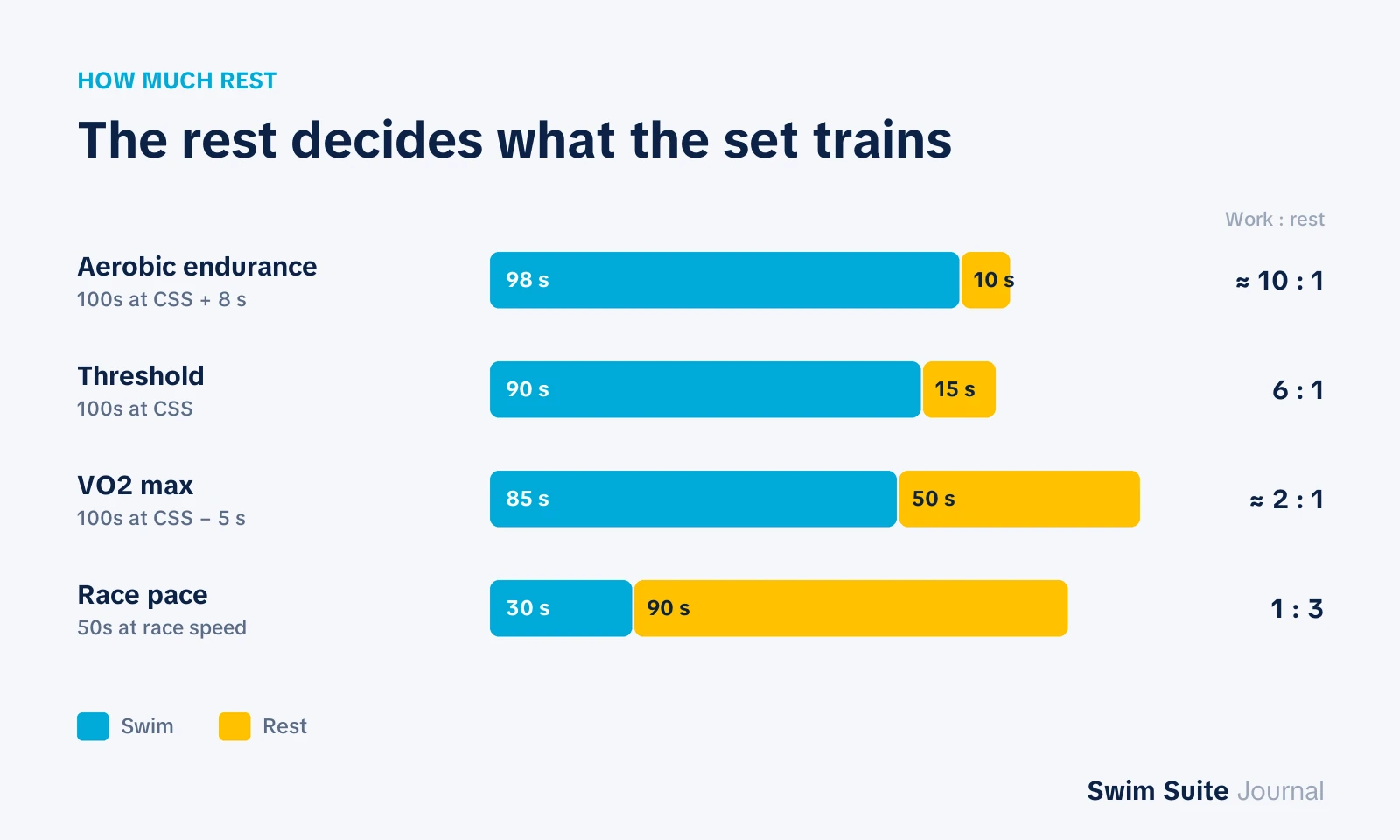
Two mistakes come up again and again. The first is one send-off for a whole lane of mixed ability: the fastest swimmer gets a minute of rest on a threshold set while the slowest gets five seconds, and neither trains what the coach planned. The second is cutting the interval to make a set harder while the swimmer's pace stays the same. Less rest at the same speed turns a VO2 max set into a threshold set; it does not make it a better VO2 max set.
Planning send-offs across a group
Intervals that fit each group mean a sum for every set, every session, and that is the part software should take off the coach. In Swim Suite every training group has its own base send-offs: per 100 for swim, kick and pull, intervals for 50s and 25s, and a standard rest. The AI-assisted session writer derives each set's intervals from them, so the same set written for two groups comes out on two different clocks. Swimmers see the day's session and the coach's targets in Swim Forge before they get in.
The base intervals should move when the swimmers do, so put a test set in the swim season plan every six to eight weeks and update them from the results. The pace clock also makes the simplest technique test there is: count strokes on a fixed send-off and you have the inputs for stroke length and stroke rate. Swim Suite plans start at €40 a month with a 14-day free trial; see plans and pricing.
What does "on the top" mean in swimming?
It means leaving when the pace clock's hand points straight up at 60, or when a digital clock shows 0 seconds. It is the default start, because the clock then shows the swimmer's time with nothing to subtract.
What is a good send-off for 100 m freestyle?
It depends on the swimmer and the set. For aerobic work, take the swimmer's comfortable 100 m pace and add 10 to 15 seconds: a club swimmer who holds 1:20 easily would swim on 1:30 to 1:35.
Why do swimmers leave five seconds apart?
So each has clear water ahead and a departure time of their own to read. Ten seconds apart is common on longer repeats or in slower lanes.